Chevron Takadai Braid

braidweaver Chevron Takadai Braid

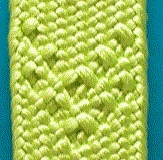
Since a long time I take a look at the Takadai braids instructions from time to time – I find them sooo beautiful!
They resemble the Kumihimo braid patterns, but the cords become flat, not round.

But I don’t have any chance to try this because I don’t have the room to place a braiding loom somewhere here.
And I think that I would lose interest very soon.
But anyhow…
;-)


Links:
Instruction for the chevron Takadai braid (Creating Pattern with Texture)
How Taka Dai Braids are Made
Description of the braiding loom (Parts of the Taka Dai)

Here at unikatissima: Entries with the tag ‘Kumihimo’

Masa Bag

Artemis Adornments Masa Bag

I found this bag when looking for Furoshiki and find it great!

It is very easy to make: crochet (Or knit. Or sew. Or weave ;-)) a big rectangle and then you only have to fold it appropriately, that’s all!


Links:
Masa Bag
Instructions for folding the Masa Bag

Here at unikatissima:
Furoshiki

Entries with the tag ‘crochet’
Entries with the tag ‘knitting’
Entries with the tag ‘sewing’
Entries with the tag ‘weaving’

2 Techniques – 1 Cord

unikatissima Fingerloop Kumihimo Cord

Recently somebody showed me a simple yet beautiful finger loop pattern.
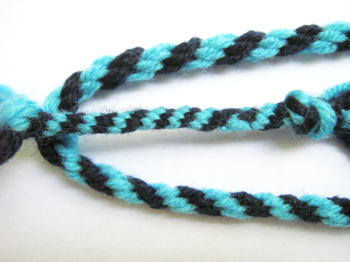
At home I tried it directly again, it is the outer cord (above and below), I braided it first to the left and then to the right.

Then I thought that I worked such a pattern in Kumihimo already, but the one I made worked a little different.
Therefore I transcribed the new finger loop pattern to a Kumihimo pattern (the middle cord on the photo).
The Kumihimo cord became much sturdier because I used quite a heavy weight.

Both are braidung techniques and I reckon that every finger loop pattern can be ‘translated’ to a Kumihimo pattern but surely not the other way round.

Afterwards I did some research and found that ‘my finger loop pattern’ has been described on the pattern page of the Fingerloop Braids Website as ‘A lace bend rounde of 8 bowes — c. 1475’ (viz. it is done with 8 loops in place of 6 loops in my case) – but I never understood the notation ;-))

Here I show you how I made the finger loop cord and the Kumihimo cord, you had perhaps problems with the notation, too ;-)


Finger loop cord

Cut 6 threads of the same length and elasticity and lay them in half to form loops.
Make 3 threads per colour (here dark blue and turquoise).
Knot the open sides together and fix them somewhere to be able to braid with the loops (you can find more detailed instructions in the links of my entry about finger loop).
 

unikatissima Fingerloop Kumihimo Cord
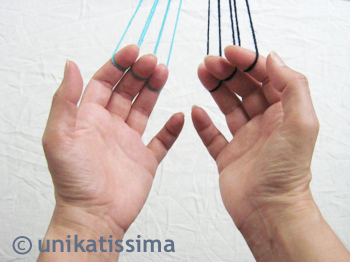
Take the loops of one colour on the index, middle finger and ring finger of one hand and those of the other colour on the corresponding fingers of the left hand.
Here I took the turquoise loops on the left and the dark blue loops on the right hand.
 

unikatissima Fingerloop Kumihimo Cord
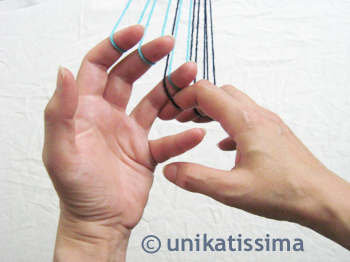
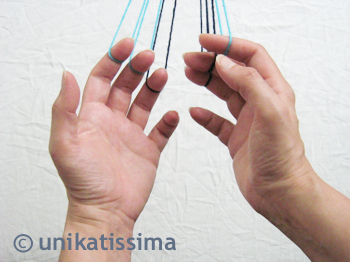
First swap the loops of the right index and the left ring finger.

To do this lay the loop of the right index behind the loop of the left ring finger…
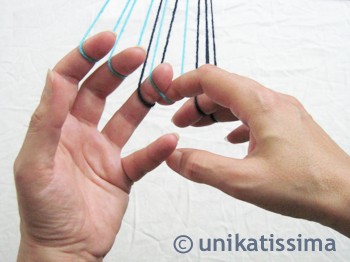
 

unikatissima Fingerloop Kumihimo Cord
…and take then the loop from the left ring finger on the right index.
 

unikatissima Fingerloop Kumihimo Cord
You have now on the left hand two turquoise loops (on the index and the middlefinger) and a dark blue loop (on the ring finger) and on the right hand one turquoise loop (on the index) and two dark blue loops (on the middle and the ring finger).

Note: I didn’t take a photo of it, but after every swap open your arms wide to tighten the braid and make it sturdier.
 

unikatissima Fingerloop Kumihimo Cord
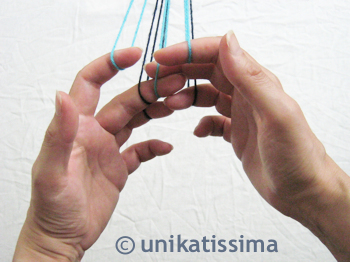
Next swap the loops of both middle fingers in the same way.
 

unikatissima Fingerloop Kumihimo Cord
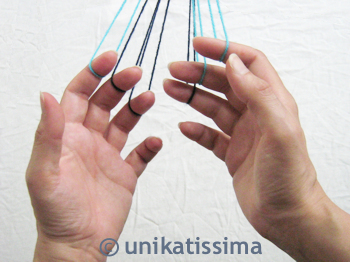
You have now on the left hand one turquoise and two dark blue loops and on the right hand the other way round.
 

unikatissima Fingerloop Kumihimo Cord
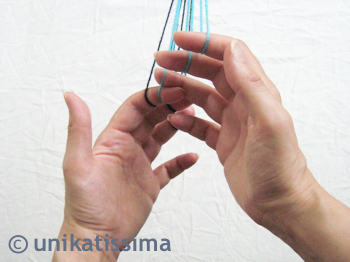
For now the last step is the swap of the loops of the right ring finger and the left index.
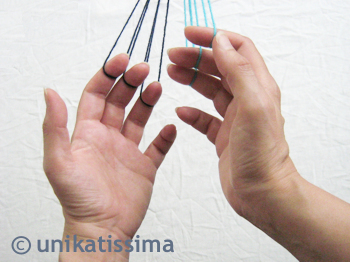
 

unikatissima Fingerloop Kumihimo Cord
Now you have all three turquoise loops on the right hand and the dark blue loops on the left hand.

That’s been the first half of the steps to do.
Repeat all steps (index right-ring finger left-swap, middle finger-swap, ring finger right-index left-swap) to bring back the turquoise loops to the left hand and the dark blue loops to the right hand, then you have braid a full round.

Repeat the steps until your cord is of desired length.


Kumihimo cord

Cut here too threads of the same length and elasticity, but this time cut 6 threads of one colour (here turquoise) and 6 in another (here dark blue).
I made the cord on my cardboard marudai, but it was no fun at all because you have to re-lay the threads for this pattern to their appropriate places at every braid.
At least by now is the moment to ‘construct’ a marudai (links to self-made marudai in my Kumihimo entry).
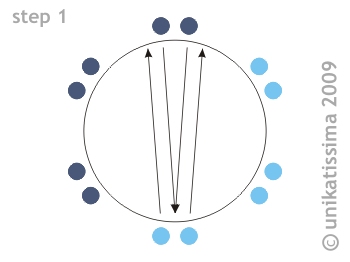
 

unikatissima Fingerloop Kumihimo Cord
Sort your threads as shown in the graphic.
Lay the upper dark blue thread pair between the threads of the lower turquoise thread pair and then lay both turquoise threads where the dark blue ones have been.
Push together the thread pairs to clearly separate them from each other.
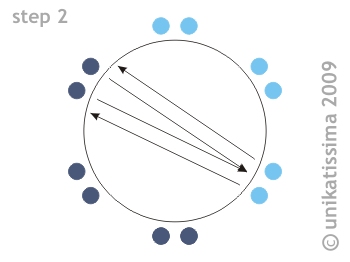
 

unikatissima Fingerloop Kumihimo Cord
In the second step you do the same with the dark blue thread pair top left and the turquoise thread pair down right.
Here again push together the thread pairs neatly.
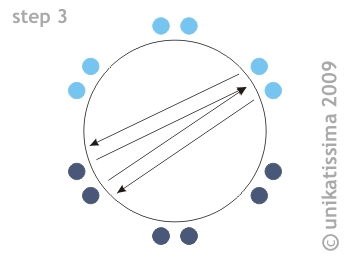
 

unikatissima Fingerloop Kumihimo Cord
In the third step you do the same with the dark blue thread pair down left and the turquoise thread pair top right.

That was the first half of the steps and here, too, the steps must be repeated to get back to the original colour distribution:
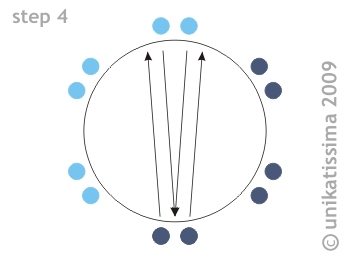
 

unikatissima Fingerloop Kumihimo Cord
Lay the upper turquoise thread pair between the threads of the lower dark blue thread pair and then lay both dark blue threads where the turquoise ones have been.
Always push together the thread pairs neatly.
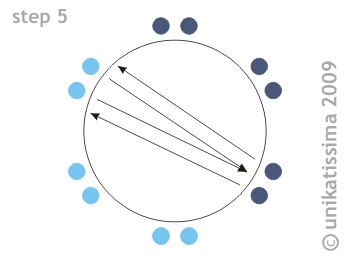
 

unikatissima Fingerloop Kumihimo Cord
In the fifth step do the same with the turquoise thread pair top left and the dark blue thread pair down right.
Here again push together the thread pairs neatly.
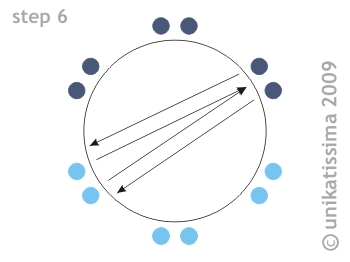
 

unikatissima Fingerloop Kumihimo Cord
In the last step of this round you do the same with the turquoise thread pair down left and the dark blue thread pair top right.
As always push together the thread pairs neatly.

You have finished the first round now, repeat all six steps until your cord has the desired length.

Have fun with the comparison of the two techniques finger loop and Kumihimo and make some beautiful cords :)


Links:
Marca brandenburgensis anno domini 1260 – that’s where the woman came from who showed me the pattern

Fingerloop Braids Website: Fingerloop Braid Patterns
and there:
the finger loop pattern that I presented here, but with 8 loops (‘A lace bend rounde of 8 bowes — c. 1475’)

Here at unikatissima:
Finger loop
for more detailed instructions see there the links

Kumihimo
   for the construction of a self-made marudai see there the links
   my template for a cardboard marudai

On this page:
Instruction for finger loop cord
Instruction for Kumihimo cord
Cross Stitch Patterns Treasures

myauntsattic Cross Stitch Patterns

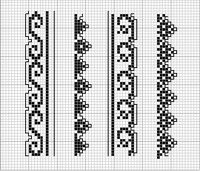
I found a blog where the author fetched the cross stitch patterns of an old aunt from the attic and published them.
I saw beautiful patterns thereby and it’s not as if you had to work cross stitch only with the patterns ;-)

The blog is written in Netherlands and English (the italic text), but the patterns can be recognized anyhow ;-))


Links:
Cross Stitch Patterns Treasures (Tantes zolder) (Netherlands and English)

Here at unikatissima:
What Can You Do With Filet Crochet/Cross Stitch Embroidery Charts?

Woven Plastic Bag

instructables Woven Plastic Bag

I presented already the tote which is crocheted from plastic bags which were cut in stripes and the makeup bag made from fused plastic bags, this is yet another bag that uses nevertheless both techniques.

I find it great but won’t make it because here all plastic bags look the same and frankly, I find that it would look boring, then.


Links:
Woven Plastic Bag (Tone twister bag)

Here at unikatissima:
Plastic Bag Tote
Fabric from Plastic Bags

Woven Button Coaster

craftstylish Woven Button Coaster

Isn’t it great?
Up until now I thought that you have to use really beautiful, extraordinary buttons for button crafts, but if you make the button coaster common buttons are enough and it looks wonderful even so!

My list grows longer ;-)


Links:
How to Make a Woven Button Coaster
via: Tutorial: Woven Button Coasters

Here at unikatissima: Entries with the tag ‘button’

Hand Knit-Weave

unikatissima Hand Knit-Weave

I discovered recently ‘knit weave’ (you can see pictures when following the links).
I like it! ;-)

Knit weave is mostly worked on knitting machines by laying a thread on the stitches. This thread is then trapped in the stitches and can be seen sometimes on the front side, sometimes on the back side of the item.
I found this interesting and thought that it should be possible to do this by hand.
I didn’t find very much (see links), therefore I’m reporting my own experience here.
Just a note: ‘knit weave’ can be translated in German by ‘Webstricken’, but when googling Webstricken you get quite different results: there are knitting needles where you can thread in an extra thread that will be worked in your item when knitting. But it looks different from ‘my’ knit weave.


That’s what you do:
In principle you carry an extra thread with you that will be laid on the front side and the back side of your work, alternately. That’s like weaving: the weft will be brought over and under.
I suggest not to let the extra thread lay on one side longer than four stitches. The float will get too long and your fingers can get caught.
Always check the extra thread tension to prevent it from hanging or contracting the knitted stitches.
You can see best what I’m talking about when checking the following examples:


unikatissima Hand Knit-Weave
My first item.
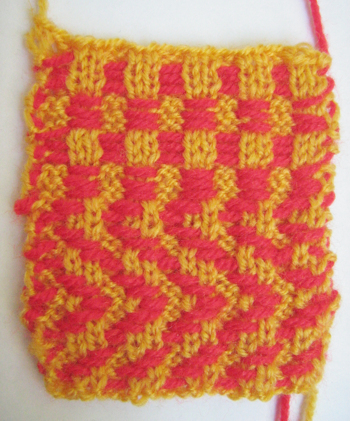
I knitted the yellow item in a rib pattern two knit-two purl to prevent it from curling.
While knitting I carried a red thread that I always laid two stitches on the front side and two stitches on the back side of my work.
The back side looks similar.


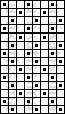
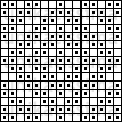
unikatissima Hand Knit-Weave Pattern unikatissima Hand Knit-Weave Pattern These are both patterns I used for my first item.
A filled square means: ‘lay the thread on the front side of your work’, an empty square means therefore ‘lay the thread on the back side of your work’.

(To download simply click on the image with the right mouse button and use something like ‘Save image as…’.)


unikatissima Hand Knit-Weave
My second item: This time I used kitchener stitch and I was pleasantly surprised to see that the item nearly don’t curl when knit woven.
Note: I’ve been told that this is not the kitchener stitch but the stockinette stitch.
In the end it doesn’t matter which stitch you use (to a certain point ;-)), but I see that I have still lots to learn about the English knitting vocabulary ;-)).


unikatissima Hand Knit-Weave
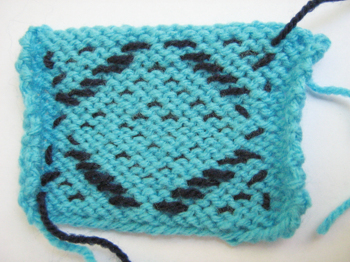
Here the back side: just as with multi-coloured knitting.


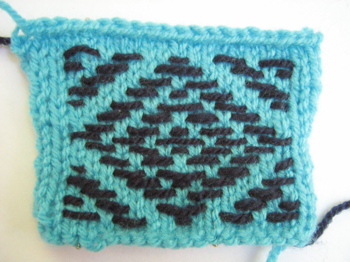
unikatissima Hand Knit-Weave Pattern That is the diamond pattern I used for my second item.
(The download works in the same way as above.)


unikatissima Hand Knit-Weave
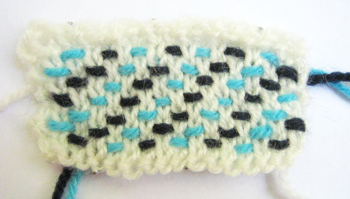
Then I wanted to know whether it works with two colours, too.
I think it does ;-))


unikatissima Hand Knit-Weave
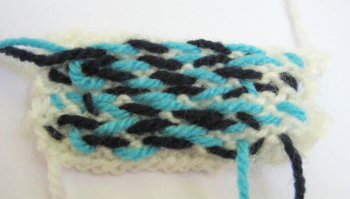
The item gets however quite thick because of the many yarns.
Besides I’m sure that you can make the whole thing much neater ;-)


unikatissima Hand Knit-Weave Pattern So, that is the two-colour pattern.
A square filled with a filled square (eehm…) means: ‘dark blue thread on the front side of the item’, a square filled with an empty square means: ‘light blue thread on the front side of the item’, an empty square means: ‘all extra threads on the back side of the item’.


unikatissima Hand Knit-Weave
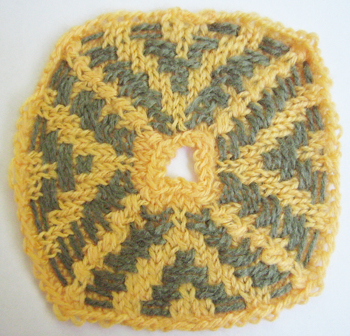
In the end I just played around with an extra: I knitted the (hmpf!) square from outside to inside in kitchener stitch by knitting three stitches together in the corners in every second row.
I carried the gray extra thread that I laid on the front side every second row shifted for one stitch.

Unfortunately I blocked the square made from acrylic yarn too hot, that ‘s why I can’t get it square anymore ;-(


unikatissima Hand Knit-Weave
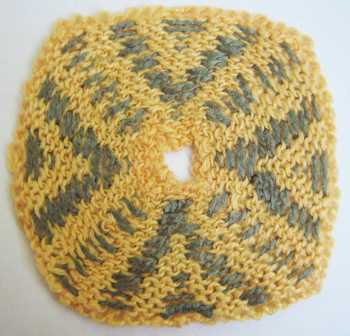
Here you can see the back side of the square.
The pattern is inverted and look also nice.


What I want to try next:

  • In the links you can find photos combining knit weave and lace knitting, I like this.
  • I want to carry a funky yarn once to see if one can still recognize the patterns.
  • I haven’t tried yet whether you can carry more than two extra threads.


Links:
Short Description ‘Knit-woven Effects’

Photos of machine knit woven pieces (with lace knitting)
Photos of machine knit woven pieces

Knit-Weave Patterns

A short movie about the technique that she uses there to weave in fur yarn => look there for ‘Hand knit-weave technique’

Meine kleine Buchkritik – My little book review: Kathleen Kinder, ‘The technique of Knitweave’) (German and English): actually I refer to the pictures because the reviewed book is about machine knit weave

Garden Decorations


After I presented Jewelry for the Garden some time ago and yesterday the Tomato Tube Leaves I want to present today three more garden decorations from joghurt cup lids and acrylic yarn.

 
Instruction for the 1. decoration, the 2. decoration, the 3. decoration


1. decoration

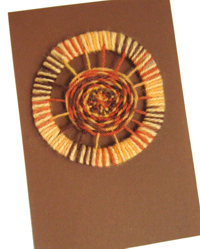
unikatissima Garden Decorations As you can see the ornament can be used for a greeting card as well ;-)
 

unikatissima Garden Decorations a
I used a transparent joghurt cup lid (from a 500g joghurt cup) and variegated acrylic yarn.
Additionally you will need a darning needle.


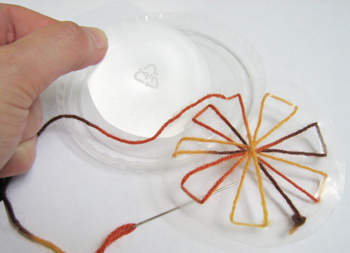
unikatissima Garden Decorations a Template Cut a broad rim from the lid and prick 16 holes.
Then weave a spiderweb through the pre-pricked holes.

You can click the thumbnail of the template to download the enlarged template. The template is about 10 cm (appr. 4 inches), if your lid size is different you will possibly have to adapt the print size.


unikatissima Garden Decorations a
Weave the spiderweb: always over and under the threads, as long as you like.


unikatissima Garden Decorations a
Subsequently I complemented the yarn with another with a matching colour and wrapped both around the broad plastic rim.
The crochet hook made the work sometimes easier but isn’t necessary.


I glued the ornament onto a card but you can attach it to a wooden stick, e.g. a kebab skewer, too, and put into a flower box or a flower bed.


2. decoration

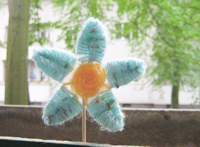
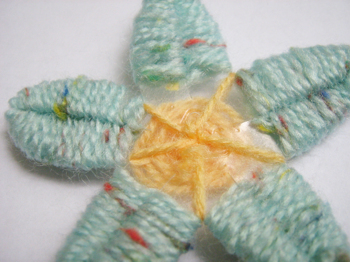
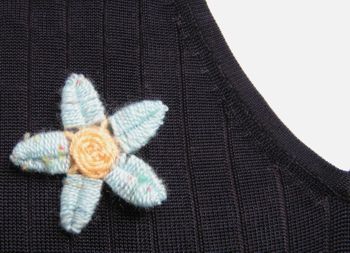
unikatissima Garden Decorations b I made this ornament with a lid from the same joghurt and with acrylic yarn, also.
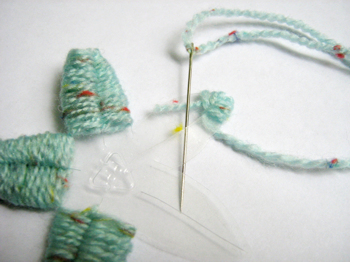
 

unikatissima Garden Decorations b Template Cut your joghurt cup lid following this template (click the thumbnail of the template to download the enlarged template. The template is about 10 cm (appr. 4 inches), if your lid size is different you will possibly have to adapt the print size.)

You must also cut the black lines in the petals, but they must not reach the edge.


unikatissima Garden Decorations a
Begin ‘in’ a petal and weave both wings of the petal in eights until they are completely covered in yarn (from the center to the left and back to the center, from the center to the right and back to the center, repeat).


unikatissima Garden Decorations a
Then prick a hole in the center of the flower and weave a net (in a contrasting colour) (see photo).


unikatissima Garden Decorations a
Weave the yarn around the threads, always over and under the thread.


unikatissima Garden Decorations a
If you use the ornament as a pin or for a greeting card it is enough to weave only one side of the flower, otherwise you must work on both sides.


3. decoration

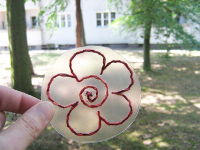
unikatissima Garden Decorations c Of course this ornament has been made with a lid from the same joghurt and with acrylic yarn ;-)
This time a darning needle is absolutely necessary.


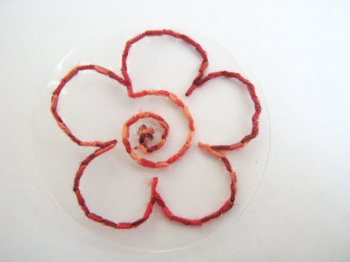
unikatissima Garden Decorations c Template Cut and prick your joghurt cup lid following this template (click the thumbnail of the template to download the enlarged template. The template is about 10 cm (appr. 4 inches), if your lid size is different you will possibly have to adapt the print size.)


unikatissima Garden Decorations c
Simply embroider the pattern: always in and out and if you like, back again.


Links:
Here at unikatissima:
Jewelry for the Garden
Tomato Tube Leaves

Here on this page:
Instruction for the 1. decoration
Instruction for the 2. decoration
Instruction for the 3. decoration

Weave Wrapped Bead Buttons

unikatissima Embroidered Bead Buttons

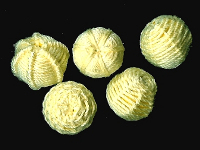
Once I found an instruction on making buttons by weave wrapping wooden beads and tried it immediatley with different weave patterns: It is great!
I really like the weave wrapping of the buttons and find that the results are too beautiful to be used as buttons, I like them more as beads ;-)


Links:
Weave Wrapped Bead Buttons – scroll down to ‘To construct this type of button,…’

Here at unikatissima: Entries with the tag ‘button’