Sun Card

unikatissima Sun Card

Recently I needed a card for a man which had to show the colours wine red and gold.
What is more I wanted it simple yet elegant and I think that it worked out ;-))
(Click the picture to get an enlarged view.)


unikatissima Sun Card Inside The pattern shows inside, too.
Because I didn’t like the writing to be directly on the wine red I put a crème coloured paper in.


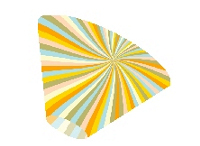
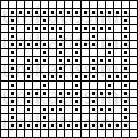
unikatissima Sun Card Template You can click the thumbnail of the template to download the enlarged template. The template is about 10 cm (appr. 4 inches), if you like to have a different size you will have to adapt the print size.

Simply lay the template on your card and prick all holes where you want to thread the yarn through (there are several possibilities, just try it).
Then weave in the thread.


Note: If you use an overlong thread you only get a thread tangle.
That’s why I worked in rings that I finished one by one.
You can find the technique that I used to thread the yarn through the hole in the entry Starburst Card.
I finished the ends of the threads on the backside as invisible as possible by laying them side by side and glueing them on.
In case that the backside of your card doesn’t look nice you can glue on a different coloured paper on both sides, that looks very good and conceals all imperfections.


Links:
Here at unikatissima:
Starburst Card: I show there how I weave the thread through the holes, here I did it the same way
Entries with the tags ‘paper’ and ’embroidery’

Garden Decorations


After I presented Jewelry for the Garden some time ago and yesterday the Tomato Tube Leaves I want to present today three more garden decorations from joghurt cup lids and acrylic yarn.

 
Instruction for the 1. decoration, the 2. decoration, the 3. decoration


1. decoration
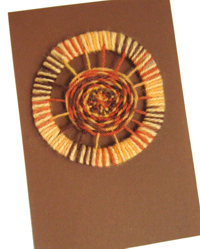
unikatissima Garden Decorations As you can see the ornament can be used for a greeting card as well ;-)
 

unikatissima Garden Decorations a
I used a transparent joghurt cup lid (from a 500g joghurt cup) and variegated acrylic yarn.
Additionally you will need a darning needle.
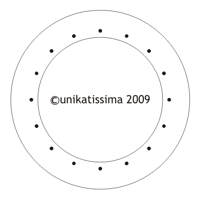
 

unikatissima Garden Decorations a Template Cut a broad rim from the lid and prick 16 holes.
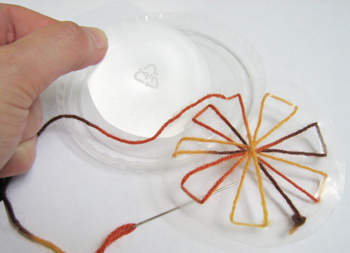
Then weave a spiderweb through the pre-pricked holes.

You can click the thumbnail of the template to download the enlarged template. The template is about 10 cm (appr. 4 inches), if your lid size is different you will possibly have to adapt the print size.


unikatissima Garden Decorations a
Weave the spiderweb: always over and under the threads, as long as you like.


unikatissima Garden Decorations a
Subsequently I complemented the yarn with another with a matching colour and wrapped both around the broad plastic rim.
The crochet hook made the work sometimes easier but isn’t necessary.


I glued the ornament onto a card but you can attach it to a wooden stick, e.g. a kebab skewer, too, and put into a flower box or a flower bed.


2. decoration
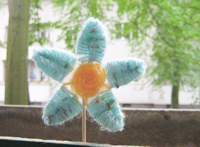
unikatissima Garden Decorations b I made this ornament with a lid from the same joghurt and with acrylic yarn, also.
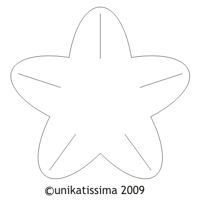
 

unikatissima Garden Decorations b Template Cut your joghurt cup lid following this template (click the thumbnail of the template to download the enlarged template. The template is about 10 cm (appr. 4 inches), if your lid size is different you will possibly have to adapt the print size.)

You must also cut the black lines in the petals, but they must not reach the edge.
 

unikatissima Garden Decorations a
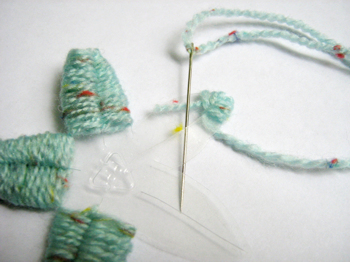
Begin ‘in’ a petal and weave both wings of the petal in eights until they are completely covered in yarn (from the center to the left and back to the center, from the center to the right and back to the center, repeat).


unikatissima Garden Decorations a
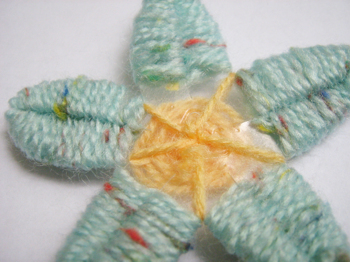
Then prick a hole in the center of the flower and weave a net (in a contrasting colour) (see photo).
 

unikatissima Garden Decorations a
Weave the yarn around the threads, always over and under the thread.
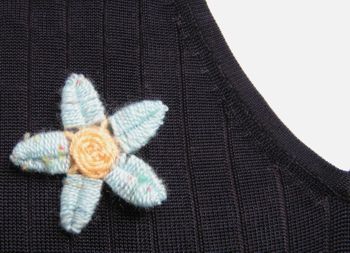
 

unikatissima Garden Decorations a
If you use the ornament as a pin or for a greeting card it is enough to weave only one side of the flower, otherwise you must work on both sides.


3. decoration
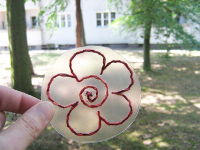
unikatissima Garden Decorations c Of course this ornament has been made with a lid from the same joghurt and with acrylic yarn ;-)
This time a darning needle is absolutely necessary.
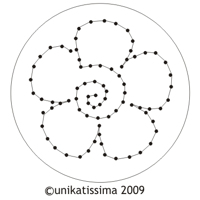
 

unikatissima Garden Decorations c Template Cut and prick your joghurt cup lid following this template (click the thumbnail of the template to download the enlarged template. The template is about 10 cm (appr. 4 inches), if your lid size is different you will possibly have to adapt the print size.)
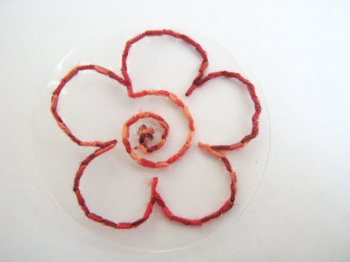
 

unikatissima Garden Decorations c
Simply embroider the pattern: always in and out and if you like, back again.


Links:
Here at unikatissima:
Jewelry for the Garden
Tomato Tube Leaves

Here on this page:
Instruction for the 1. decoration
Instruction for the 2. decoration
Instruction for the 3. decoration

Tomato Tube Leaves

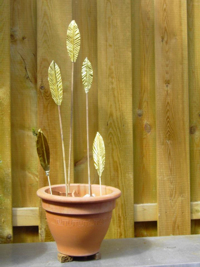
unikatissima Tomato Tube Leaves
Don’t those golden leaves look great?
A dear friend made them from (admittedly mustard ;-)) tubes and allowed me to show here how to make them.
Many thanks again!


That’s what you do:


unikatissima Tomato Tube Leaves
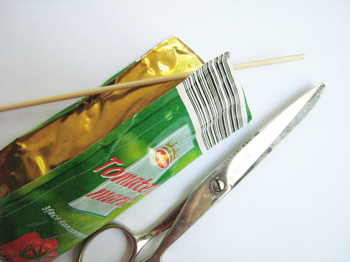
You need a (clean and empty! ;-)) tube with golden internal coating, scissors and a wooden stick, e.g. a kebab skewer.


unikatissima Tomato Tube Leaves
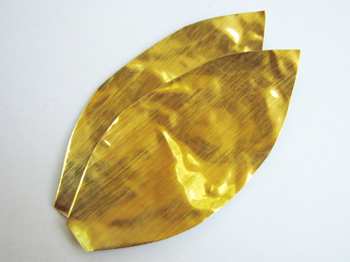
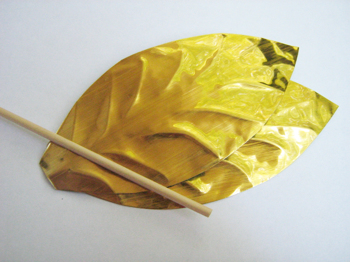
I folded up the tube which was cut open on three sides and cut out two equal leaves.


unikatissima Tomato Tube Leaves
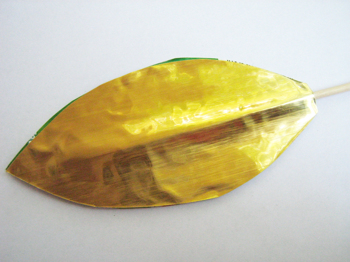
First I flattened the leaves slightly and then I put the kebab skewer in and pressed them lightly until the midrib of the leaf begun to show.


unikatissima Tomato Tube Leaves
Then I scratched the leaf ribs with the back of my kebab skewer from the backside of every leaf.


unikatissima Tomato Tube Leaves
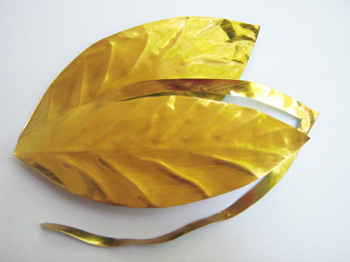
Afterwards I reduced one leaf by cutting away an edge of about 3 mm.


unikatissima Tomato Tube Leaves
I put both leaves on top of one another and scratched the outline of the smaller leaf slightly with the tip of my kebab skewer into the larger leaf.
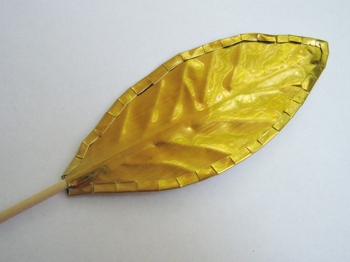
Then I cut the edge of the larger leaf from the rim to the scratched line of the smaller leaf about every 5 mm.


unikatissima Tomato Tube Leaves
I put both leaves on top of one another with the golden sites outwards and folded back the sections.


unikatissima Tomato Tube Leaves
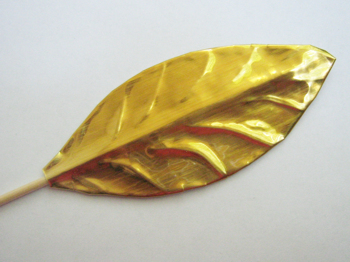
At the end I stuck the kebab skewer between the leaves.

You can stuck it in also before folding back the sections, just as you like it.


unikatissima Tomato Tube Leaves
My friend additionally glued on the kebab skewer but we both don’t know if this is necessary ;-))


Have much fun decorating your flower boxes and garden flower beds :)

Clothesline Knitting or Filled I-cord

unikatissima Clothesline Knitting

Recently I thought about how to make low-priced purse handles. I wanted to make them from the same yarn that I will use for my purse but I didn’t want to have a simple I-cord because I’m always knitting very loose and the cord gets much to flexible for a purse handle.

Then I thought about the Clothesline Crochet and thought that this must be possible with knitting, too.
It is ;-))

Note: If you don’t know how to knit an I-cord you can find instructions in my Actinia entry in the English tutorial under ‘I-cord’.


That’s what you do:
I choose a thick ready-made cord to cover with knitting.
The number of stitches to cast-on depends on the size of the cord, the yarn and the needles (try it!), in this case I used five stitches.


unikatissima Clothesline Knitting
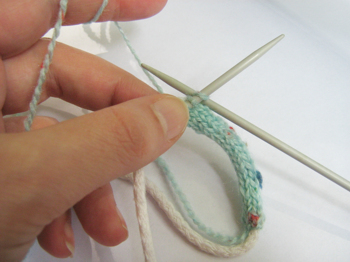
So, cast-on the stitches, lay the inner cord in (see photo) and knit the first stitch over the inner cord.
The inner cord will be trapped in the stitch.


unikatissima Clothesline Knitting
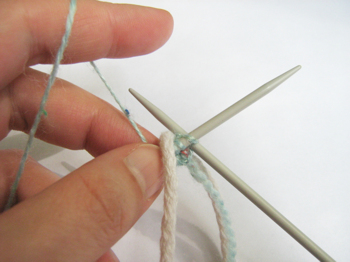
Then knit simply the rest of the stitches, lay the inner cord a little beside (see photo).


unikatissima Clothesline Knitting
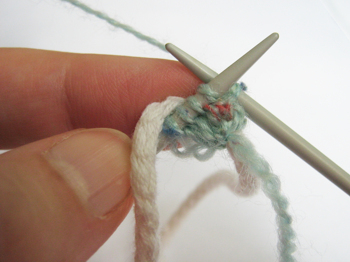
In the next row lay the inner cord again over the left needle to the right of the thread just as in the first photo, knit the first stitch over the inner cord and knit then the other stitches.

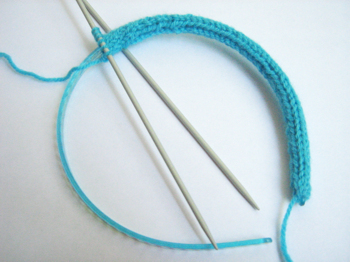
Knit in the same way until you reach the desired length.


unikatissima Clothesline Knitting
Somewhere (and I really don’t remember, where) I saw a tutorial where they glued on hairbands to make the purse handles.
I thought that I should be able to knit around the hairbands just as I knitted the inner cord, but it didn’t work.
What however worked was knitting an I-cord and threading the hairband into, so that the hairband is covered and I even have threads to sew the handles onto the purse.


Links:
Here at unikatissima:
Tutorial on how to knit an I-cord in the English tutorial in the Actinia entry under ‘I-cord’

Online Pattern Generator (Cellular Automaton)

unikatissima Cellular Automaton Generator

I wrote another online pattern generator that you can use in a manner of speaking for ‘nearly everything’ ;-), but this time not for maze patterns, but for patterns that are made with a so called cellular automaton.


To tell you the truth, I haven’t as yet understood fully what a cellular automaton is ;-)

Everything began when I saw this knitted Cellular Automata Tea Cozy.
I found the pattern quite funny, so I made a little research and when I found the many different patterns that such a cellular automaton can generate I was dead set on writing an online pattern generator for such patterns.

Ta-DAA! And here it is.

A suggestion: If you don’t like a (random) pattern, simply click the ‘random’ or the ‘random random’ button again, some of the patterns differ considerably from each other!
And if you don’t know exactly what to do with the diagrams simply read again my entry ‘What Can You Do With Filet Crochet/Cross Stitch Embroidery Charts?’ ;-)

I wish you a lot of fun with it!

By the way: On the photo you see my first printed patterns, yarn in two colours, some beads, crochet and knitting needles.
I simply can’t settle for a project to begin ;-))


Links:
unikatissima’s Pattern Generator (Cellular Automaton)
unikatissima’s Maze Pattern Generator

Cellular Automata Tea Cozy
via: k2g2Mathematical Craft Projects

Elementary Cellular Automaton

Here at unikatissima:
What Can You Do With Filet Crochet/Cross Stitch Embroidery Charts?

Online Cone Calculator

My entry ‘Constructing a Cone’ was much to wordy ;-), therefore I wrote an online cone calculator.


Note: Unfortunately the online cone calculator seemingly doesn’t work under all circumstances and I don’t have the time to struggle through. That’s why I write the formula by all means behind.

Well, you have disabled javascript, which means that the online cone calculator doesn’t work anyway.

You have 2 options now:

  • enable javascript
  • calculate the cone data yourself using the following formula.


Formula:

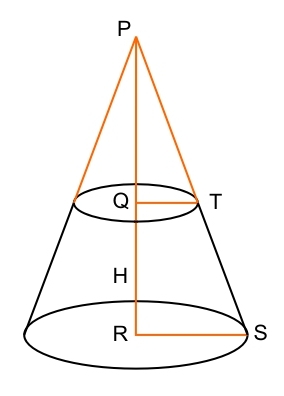
The black cone is what we want to get.
small diameter = smaller desired diameter
large diameter = larger desired diameter
height = desired height
QT = small diameter / 2
RS = large diameter / 2
PQ = QT * height / (RS – QT)
PR = PQ + height

PT = √((PQ * PQ) + (QT * QT));
PS = √((PR * PR) + (RS * RS));
(√ is sqrt is square root)

angle to cut away =
360 * (1 – ((2 * π * RS) / (2 * π * PS)))

inner circle diameter = 2 * PT;
outer circle diameter = 2 * PS;

unikatissima Example Cone


And now proceed:
Draw two centered circles with the inner and outer diameter, draw the calculated angle and cut it away.
The result should be a template for a cone with the specified measurements ;-)
If you don’t have a protractor you can print and cut the degrees disk from the entry ‘Constructing a Cone’.

If you want to know more exactly what you’re doing here, check the entry ‘Constructing a Cone’ after all ;-)


Links:
Here at unikatissima: ‘Constructing a Cone’

Chainstitch Card

unikatissima Chainstitch Card

I just wanted to show once more how beautiful embroidery on paper and cardboard can be ;-)

Here I cut a beautiful blue patterned square from a magazine and glued on white cardboard.
Then I drew very faint curved lines with a pencil, pricked holes along the lines and stitched them with a chain stitch.
Looks fine, doesn’t it?

I find though that the chain stitch looks much better on straight lines or wide curves than on sharp turns (it ‘inclines’ somewhat), that’s something one could pay attention to when drawing the lines.


Links:
Instruction for chain stitch

Here at unikatissima: Embroidered Matisse Cushion

Knitted/Crocheted Bangles

unikatissima Knitted Bangle
Recently I wanted to make some knitted napkin rings as a gift and looked for a way to 1. keep their shape and 2. make them washable.
And I really found a solution which is also great for making bangles ;-)): use a core of recycled plastic bottle and a knitted or crocheted all over cover.


That’s what you do:
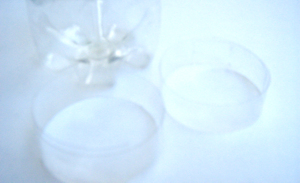
unikatissima Knitted Bangle Cut rings in the desired width from a plastic bottle.
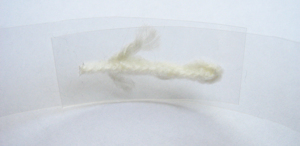
I cut here two rings because the circumference of the bottle was too small for a bangle for me.


unikatissima Knitted Bangle Where the rings are to be joined you need an overlap of about 2 cm.
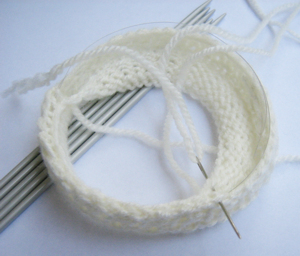
I pricked 3 holes with a pointy needle and threaded the yarn I used later for knitting through them to fix both sides. The big advantage is that you don’t see anything of this later.


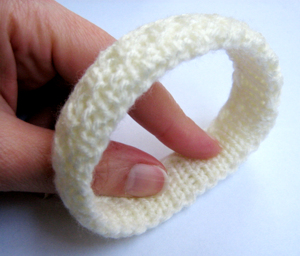
unikatissima Knitted Bangle Then knit the ‘cover’. I worked with quite thick acrylic yarn and began with a stocking stitch part for the inside whereas outside I used a moss stitch pattern.
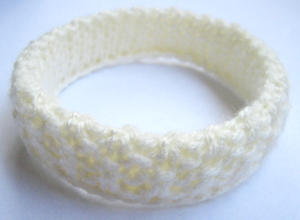
Depending on the used yarn the inside diameter can get a good deal narrower, in this case make the plastic rings a little bit larger.
When the cover is finished sew the sides together.


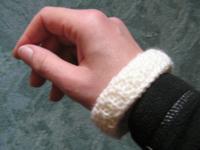
unikatissima Knitted Bangle That’s how the finished bangle looks.
Originally I wanted to have the seam at the inside of the bangle but I ‘produced’ always a thick bulged seam. Therefore I knitted the ‘folding line’ between both patterns with purls and sew at the rim (which is much easier, too ;-)).
The bulged seam looks similar to the purled row and now I like it.


unikatissima Knitted Bangle The plastic ring core has more advantages (besides the fact that it is cost-saving): the bangle keeps its shape but is flexible so that it doesn’t interfere with writing (usually I don’t wear bangles for just this reason).
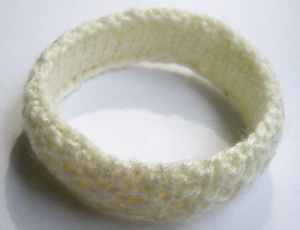
 

unikatissima Knitted Bangle What is more I can wash it: That’s how my bangle looks after I machine-washed it at 30°C together with dark(!) cloths.
No problem there ;-)
But this depends strongly from the used yarn.


I used thick acrylic yarn here and find that it looks like a winter bangle, but it can surely be crocheted as well with fine cotton thread or knitted in stocking stitch with variegated sock yarns or simply be wrapped with fun yarns, possibly even be wrapped with a sewn fabric cover…
If you try something like this I would appreciate if you’d link it in the comments!
Have much fun.
plastic bottle bracelet

Maze Pattern Generator


unikatissima Maze Generator

Yesterday I showed what can be done with filet crochet/cross stitch embroidery charts.
Today I want to present my maze pattern generator.

Some time ago I played a little around with mosaic (slip-stitch) knitting and found that mazes are as if made for that.
You can see this e.g. on the photo where I show a mosaic knitted wrist warmer.

Because I didn’t felt like always making the mazes myself, I looked in internet whether I can’t find anything and – ta-DAA! – I found the Maze Maker for which John Lauro kindly even published the algorithm (Thanks, John!).
There are more maze generators, but I found those of the Maze Maker most beautiful of all.


unikatissima Maze Generator unikatissima Maze Generator Therefore I sat down and wrote a program that generates mazes of a given size and where I can even specify the path lengths.
I let output an overview (little picture) and the pattern (template), because I find the overviews are easier to compare.


unikatissima Maze Generator Of course you can (as ‘mentioned’ yesterday ;-)) work filet crochet but also mosaic knitted wrist warmers like the one on the photo on top, …


unikatissima Maze Generator …embroidered cards (here I always pricked a little hole in the center of the little black squares which I embroidered with running stitches worked in both directions) …


unikatissima Maze Generator …and bead work (here beaded square stitch).
By the way this is a good example where the result looks different from the pattern: the beads are simply not square.


Links:
unikatissima’s Maze Pattern Generator

Maze Maker
Labyrinth Algorithmus

Instruction for running stitch

Google search result for ‘maze generator’

Here at unikatissima:
What Can You Do With Filet Crochet/Cross Stitch Embroidery Charts?
Mosaic (Slip-stitch) Knitting
Beaded Square Stitch Heart
crochet medaillon

What Can You Do With Filet Crochet/Cross Stitch Embroidery Charts?

unikatissima Two-coloured Chart (click to enlarge)

Recently something took me and I thought that you can use those two-coloured charts which are usually associated with filet crochet or cross stitch for a loooot of other techniques, too.
I had this idea already before, in my entries about intarsia knitting, the cross stitch heart, the beaded square stitch heart and the polymer clay letter cane.

On the photo you see some letters worked in different techniques (I’m working on letter charts at the moment ;-)):
'u' - Knit-Purl Knitting, each X is a purl stitch
'n' - Fair Isle Knitting, each X is a white stitch
'i' - Sequins Embroidery, each X is a sequin
'k' - Tapestry Crochet, each X is a white stitch
'a' - Filet Crochet, each X is a filled filet crochet square
't' - Cross Stitch Embroidery on paper, each X is a black cross stitch
'i' - Loom Beading, each X is a black bead
's' - Stamping with square stamps, each X is a black square stamp
's' - Illusion Knitting, each X is a black stitch over two rows
'i' - Crochet Yoyo’s, each X is a white crochet circle from dc’s
'm' - Inverted Filet Crochet, each X is a empty filet crochet square
'a' - Macramée/Friendship Bracelet, each X is a white knot

But then I came up with more techniques and if you still have more ideas I’d be glad if you wrote a comment about.
I added for every technique what would be a square of the chart.
Please remember: Not all ‘units’ are square so that the result can look quite different from the chart!

Knitting

Crochet

  • Tapestry Crochet – 1 stitch
  • Filet Crochet – 1 filet square (cross = filled square)
  • Inverted Filet Crochet – 1 filet square (cross = empty square)
  • Crochet Yoyo’s – 1 Crochet Yoyo, viz. a crochet circle from dc’s

Beading

Embroidery

Knotting

Weaving

Sewing

  • Patchwork/Quilting – e.g. 1 patchwork square
  • Yoyo’s – 1 Yoyo
  • Fabric Origami – 1 fabric origami square

Other

By the way I found an blog entry of an embroiderer who thought about the same subject and has more ideas.


Links:
Double Knitting
Picture for sequin embroidery (scroll down to about the middle)
Description of French Knot
Heather’s Friendship Bracelets – Alphabet Patterns
Geometric stitching
Google image search result for ‘yoyo blanket’
Google image search result for ‘ministeck’

Here at unikatissima:
Celtic Cross Stitch Generator
Heart Template (at Beaded Square Stitch Heart)

Patchwork Knitting
Bead Knitting
Illusion knit

Tapestry Crochet
Beautiful Filet Crochet Patterns

Loom Woven Bead Bracelet
Beaded Square Stitch Heart
Bead Knitting
Freeform Bead Embroidery
Bead embroidered Paisleys

Friendship Bracelet
Crazy Daisies
Crazy Daisies II

Tablet or Card Weaving

YoYo Pin
Fabric Origami

Mosaic Table Light (Glass Paint)
Polymer Clay Letter Cane
Mosaic from Plaster
Eraser Stamps