Stencilled Card

unikatissima Stencilled Card

(Click photo to enlarge)
Recently I needed a birthday card and that is the reason why I played around with stencilling again ;-)


unikatissima Stencilled Card
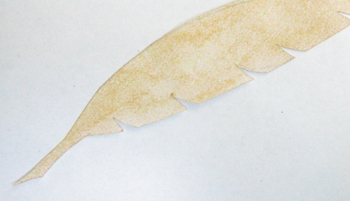
I wanted to have a negativ stencilled feather and sketched and cut therefore a feather.
Here I’ve made my first tests already.


unikatissima Stencilled Card
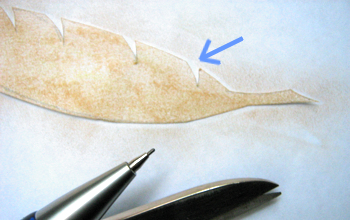
I covered my feather with light brown chalk and smeared the chalk with my fingers outwards.
This way I got white areas around my stencil which made the quill of my feather much too broad for my liking (see arrow).


unikatissima Stencilled Card
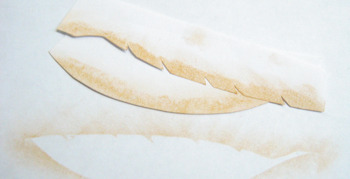
Therefore I cut two half-stencils and used them.
It worked great!
Another advantage of this half-stencil method is the fact, that the really narrow quill of my feather can’t slip or even tear anymore.


unikatissima Stencilled Card
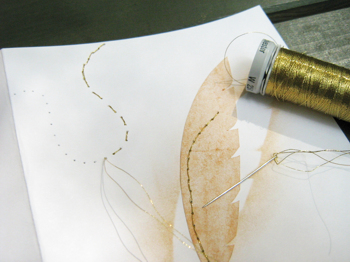
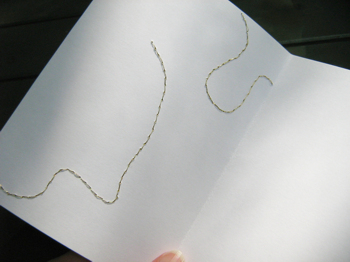
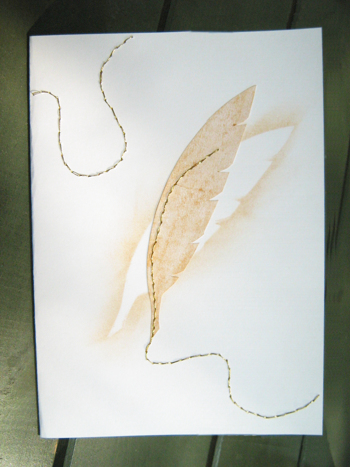
I glued a cut-out feather shifted on my stencilled feather and because I thought that something is missing, I embroidered some lines with golden thread.
I used a running stitch back and forth as I always do.


unikatissima Stencilled Card
That’s how the inside of the card looks – I left it this way and wrote on the right side of the card.


unikatissima Stencilled Card (Click photo to enlarge)
And that’s how the finished card looks: I liked it ;-) and the adressee liked it, too :)

Admittedly the card looks still a little bumpy here because I fixed the chalk with hair spray. After everything was (really!) dry I put it under a heavy book and afterwards it was beautifully flat again.


Links:
Instruction on how to make the Running Stitch (English)
Instruction on how to make the Running Stitch (Vorstich) (German)

Here at unikatissima:
Entries with the tag ‘stencil’
Entries with the tag ’embroidery’

Skinner Blend Beads Necklace


unikatissima Skinner Blend Necklace

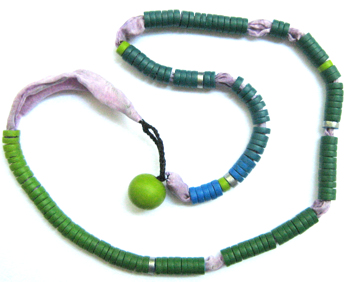
I made some nice necklaces from very narrow polymer clay beads where the bead colours are blended – and I wanted to present them now.


That’s what you do:

 
unikatissima Skinner Blend Necklace
First make a Skinner Blend (a ploymer clay slab with a colour blend).
I blended it from light green to blue.
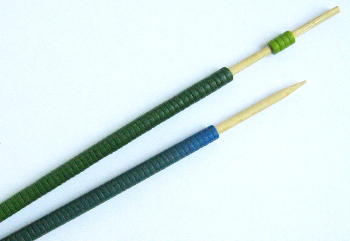
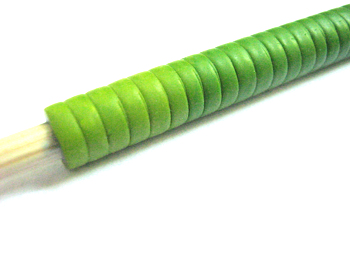
Cut the slab in stripes and wrap them around one or more kebab skewers – not too firm or you get problems taking them off, later.
Join the edges thoroughly and with care so that the beads won’t fall apart later.
At the top of the photo you see a piece of light green polymer clay, that will become contrasting beads.

By the way: If you don’t have a pasta machine for the Skinner Blend (never use a pasta machine used for polymer clay for food again!) you can find hints on how you can manage without it via the links below.


unikatissima Skinner Blend Necklace
Cut the wrapped slab with a small knife down to the skewer at regular intervals, I made my future beads about 3 mm wide.


unikatissima Skinner Blend Necklace
Bake the polymer clay following the instructions and get the beads off the skewer(s) carefully.
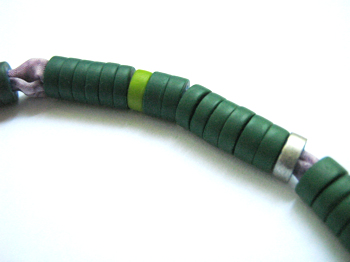
On this photo you see my light green contrasting bead that I put between the others to make it look more interesting and you see a silver bead where I don’t remember how I coloured it.
I think that I used silver coloured metallic powder that I bought for some Mica shift projects.


unikatissima Skinner Blend Necklace
I threaded my beads on a self-dyed violet silk cord and made the clasp from a black braided band and a big, round light green bead.


unikatissima Skinner Blend Necklace
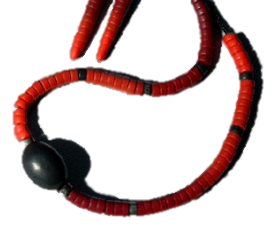
And that is a red necklace with Skinner Blend beads that I gave away – I’m sorry for the poor quality of the picture, when I took the photo at that time I didn’t know how to make good photos.
On both sides of the black central bead I let the colour blend go from light to dark red and loosened it up with narrow black beads.
The earrings are simply cones that I rounded at the top and that I carved slightly horizontally to make them match the necklace.


Links:
Skinner Blend

Don’t have a pasta machine?
Making A Jellyroll Cane Without A Pasta Machine
via: Glass Attic – Pasta machines – click on ‘No pasta machine?–other ways …guide rails’

Pasta Free Skinner Blend (Video)

Here at unikatissima:
Polymer Clay Mica Shift

Taking Photos from Jewelry
Poor Man Side Flash

Self-made Hairpin Lace Loom

unikatissima DIY Hairpin Lace Loom

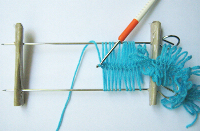
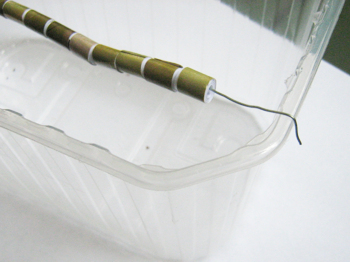
I found two tutorials on how to make a hairpin lace loom (see links below) and because I hadn’t the appropriate material at hand (in fact that’s strange seeing all the stuff I have lying here about ;-)) I did it a little different:
I took two toilet paper tubes, cut them lengthwise, rolled them up strongly and taped them all around.
Then I pricked two metal kebeb skewers through those thick cardboard rolls: my hairpin lace loom was done!
;-)

At last I could give hairpin lace a try and it – worked.


unikatissima DIY Hairpin Lace Loom
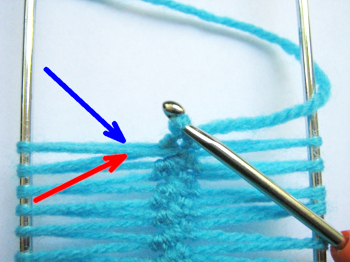
That is to say that I haven’t read the hairpin lace instruction at stichdiva thoroughly(!) and therefore it didn’t work in the beginning.
They write ‘Insert hook under thread of topmost loop’, but for me it isn’t the topmost thread (blue arrow) but the foremost thread (red arrow).
After I took the foremost thread everything worked fine.

At the moment I don’t have the time for it but in future I will play around with hairpin lace :)


Links:
Instructions for self-made hairpin lace looms:
Instruction at ehow – from metal
there you can find further down (Resources) links to hair pin lace tutorials
Instruction at Little Projects – from bamboo skewers and hot glue sticks
via: DIY Hairpin Lace Loom: the link isn’t available no more.

Tutorial for base hairpin lace at stitchdiva

Google search result for ‘hair pin lace’
Google image search result for ‘hair pin lace’
Google search result for ‘Gabelhäkelei’
Google image search result for ‘Gabelhäkelei’

2 Techniques – 1 Cord

unikatissima Fingerloop Kumihimo Cord

Recently somebody showed me a simple yet beautiful finger loop pattern.
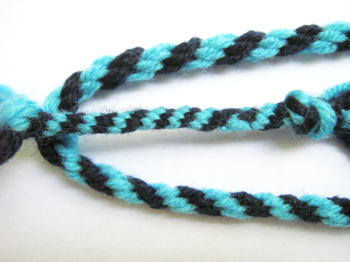
At home I tried it directly again, it is the outer cord (above and below), I braided it first to the left and then to the right.

Then I thought that I worked such a pattern in Kumihimo already, but the one I made worked a little different.
Therefore I transcribed the new finger loop pattern to a Kumihimo pattern (the middle cord on the photo).
The Kumihimo cord became much sturdier because I used quite a heavy weight.

Both are braidung techniques and I reckon that every finger loop pattern can be ‘translated’ to a Kumihimo pattern but surely not the other way round.

Afterwards I did some research and found that ‘my finger loop pattern’ has been described on the pattern page of the Fingerloop Braids Website as ‘A lace bend rounde of 8 bowes — c. 1475’ (viz. it is done with 8 loops in place of 6 loops in my case) – but I never understood the notation ;-))

Here I show you how I made the finger loop cord and the Kumihimo cord, you had perhaps problems with the notation, too ;-)


Finger loop cord

Cut 6 threads of the same length and elasticity and lay them in half to form loops.
Make 3 threads per colour (here dark blue and turquoise).
Knot the open sides together and fix them somewhere to be able to braid with the loops (you can find more detailed instructions in the links of my entry about finger loop).
 

unikatissima Fingerloop Kumihimo Cord
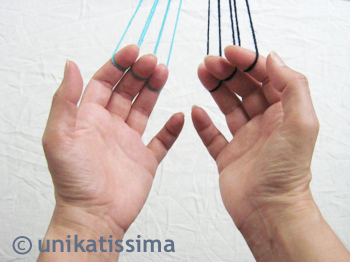
Take the loops of one colour on the index, middle finger and ring finger of one hand and those of the other colour on the corresponding fingers of the left hand.
Here I took the turquoise loops on the left and the dark blue loops on the right hand.
 

unikatissima Fingerloop Kumihimo Cord
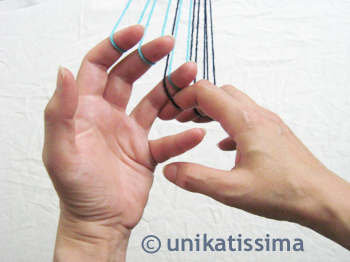
First swap the loops of the right index and the left ring finger.

To do this lay the loop of the right index behind the loop of the left ring finger…
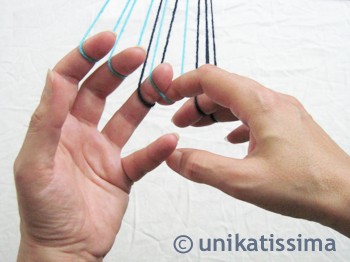
 

unikatissima Fingerloop Kumihimo Cord
…and take then the loop from the left ring finger on the right index.
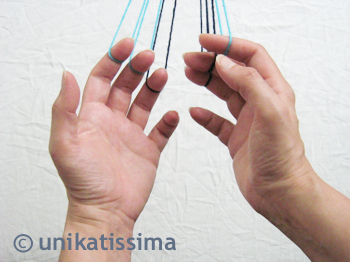
 

unikatissima Fingerloop Kumihimo Cord
You have now on the left hand two turquoise loops (on the index and the middlefinger) and a dark blue loop (on the ring finger) and on the right hand one turquoise loop (on the index) and two dark blue loops (on the middle and the ring finger).

Note: I didn’t take a photo of it, but after every swap open your arms wide to tighten the braid and make it sturdier.
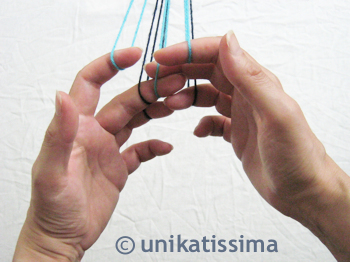
 

unikatissima Fingerloop Kumihimo Cord
Next swap the loops of both middle fingers in the same way.
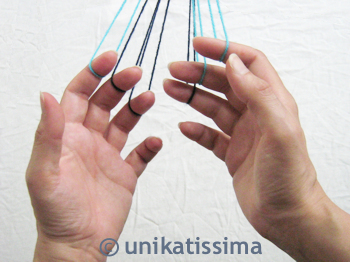
 

unikatissima Fingerloop Kumihimo Cord
You have now on the left hand one turquoise and two dark blue loops and on the right hand the other way round.
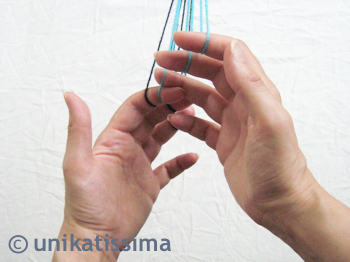
 

unikatissima Fingerloop Kumihimo Cord
For now the last step is the swap of the loops of the right ring finger and the left index.
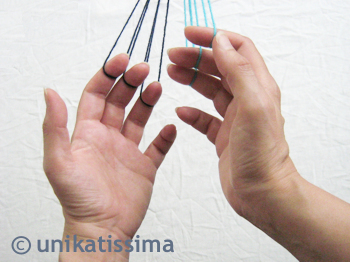
 

unikatissima Fingerloop Kumihimo Cord
Now you have all three turquoise loops on the right hand and the dark blue loops on the left hand.

That’s been the first half of the steps to do.
Repeat all steps (index right-ring finger left-swap, middle finger-swap, ring finger right-index left-swap) to bring back the turquoise loops to the left hand and the dark blue loops to the right hand, then you have braid a full round.

Repeat the steps until your cord is of desired length.


Kumihimo cord

Cut here too threads of the same length and elasticity, but this time cut 6 threads of one colour (here turquoise) and 6 in another (here dark blue).
I made the cord on my cardboard marudai, but it was no fun at all because you have to re-lay the threads for this pattern to their appropriate places at every braid.
At least by now is the moment to ‘construct’ a marudai (links to self-made marudai in my Kumihimo entry).
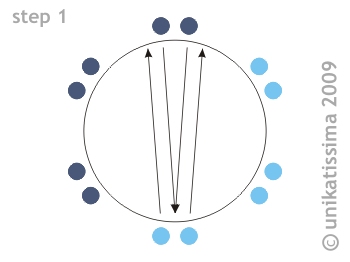
 

unikatissima Fingerloop Kumihimo Cord
Sort your threads as shown in the graphic.
Lay the upper dark blue thread pair between the threads of the lower turquoise thread pair and then lay both turquoise threads where the dark blue ones have been.
Push together the thread pairs to clearly separate them from each other.
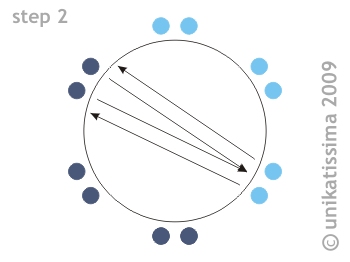
 

unikatissima Fingerloop Kumihimo Cord
In the second step you do the same with the dark blue thread pair top left and the turquoise thread pair down right.
Here again push together the thread pairs neatly.
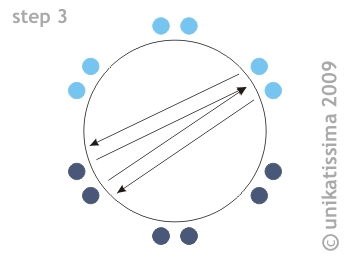
 

unikatissima Fingerloop Kumihimo Cord
In the third step you do the same with the dark blue thread pair down left and the turquoise thread pair top right.

That was the first half of the steps and here, too, the steps must be repeated to get back to the original colour distribution:
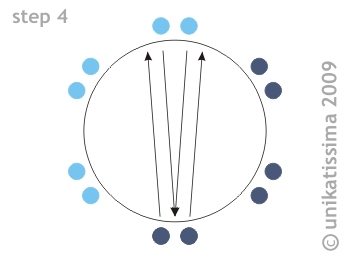
 

unikatissima Fingerloop Kumihimo Cord
Lay the upper turquoise thread pair between the threads of the lower dark blue thread pair and then lay both dark blue threads where the turquoise ones have been.
Always push together the thread pairs neatly.
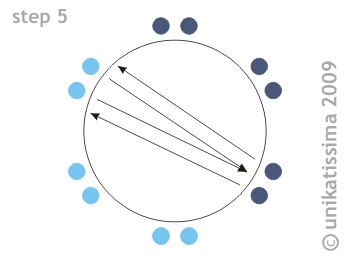
 

unikatissima Fingerloop Kumihimo Cord
In the fifth step do the same with the turquoise thread pair top left and the dark blue thread pair down right.
Here again push together the thread pairs neatly.
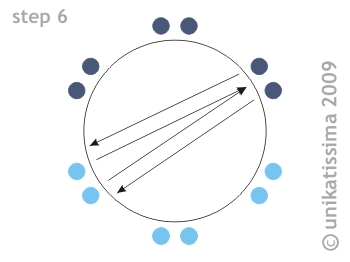
 

unikatissima Fingerloop Kumihimo Cord
In the last step of this round you do the same with the turquoise thread pair down left and the dark blue thread pair top right.
As always push together the thread pairs neatly.

You have finished the first round now, repeat all six steps until your cord has the desired length.

Have fun with the comparison of the two techniques finger loop and Kumihimo and make some beautiful cords :)


Links:
Marca brandenburgensis anno domini 1260 – that’s where the woman came from who showed me the pattern

Fingerloop Braids Website: Fingerloop Braid Patterns
and there:
the finger loop pattern that I presented here, but with 8 loops (‘A lace bend rounde of 8 bowes — c. 1475’)

Here at unikatissima:
Finger loop
for more detailed instructions see there the links

Kumihimo
   for the construction of a self-made marudai see there the links
   my template for a cardboard marudai

On this page:
Instruction for finger loop cord
Instruction for Kumihimo cord
Flower Flap Box

unikatissima Flower Flap Box

I saw somewhere (unfortunately I don’t remember where) such a box, but it was flat while I wanted the actual box (not the flaps) to be of about 2 cm height.
So I made me a template myself ;-))


And that’s what you do:
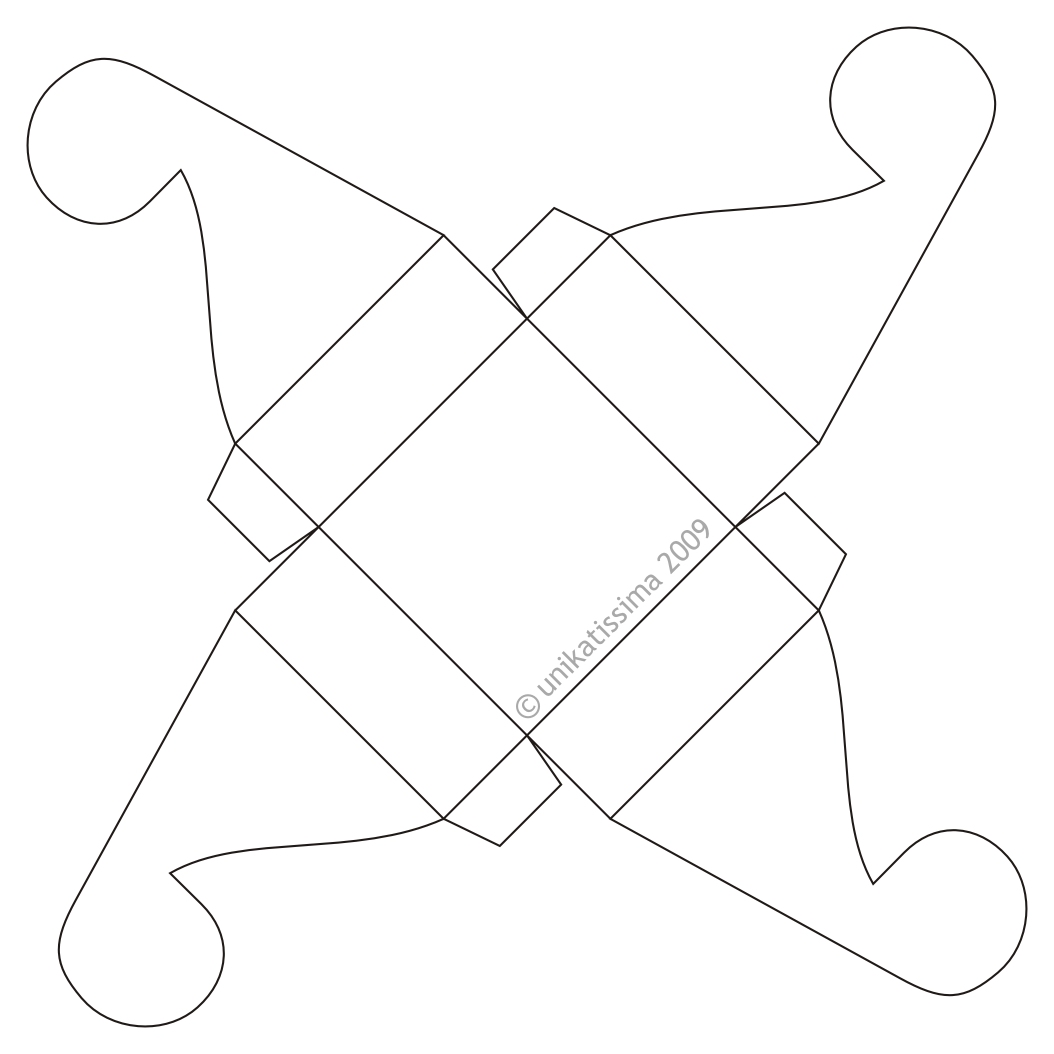
unikatissima Flower Flap Box Template (Click to enlarge)
That is the template.


Instruction for first box: Pasted paper


unikatissima Flower Flap Box
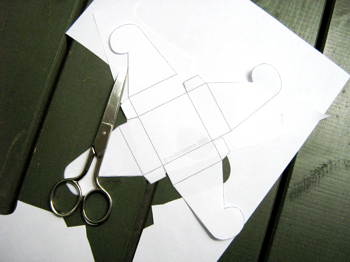
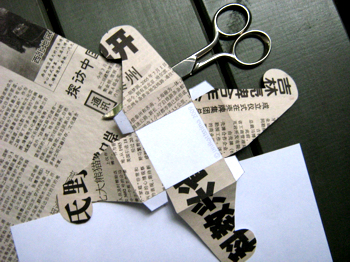
First print the template and cut it.


unikatissima Flower Flap Box
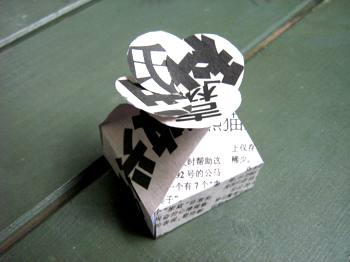
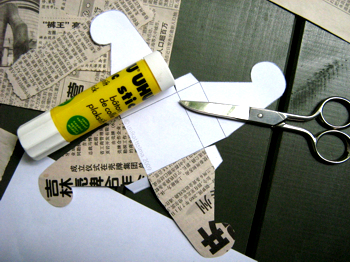
I wanted to have a Chinese box so I pasted the outside up with some Chinese newspapers that I stained with tea before (see links below).
Of course you can paste the paper up with gift wrapping, snippets from ads and so on, too.
I suggest to paste a second layer on the paper in any case to get it sturdier or to use thin cardboard.


unikatissima Flower Flap Box
When having pasted up all four flaps you can pre-fold the box. This way it will be easier to glue the tags.


unikatissima Flower Flap Box
Here is the glue setting.
You can see that I didn’t paste up the inside.


unikatissima Flower Flap Box
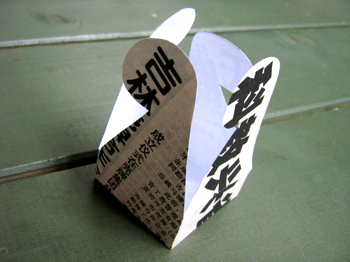
And that is the box in its full beauty ;-)
I suggest to let the glue set well because there will be some strain when you close the box and the tags can get unfixed.

Instruction for second box: Thin cardboard
 

unikatissima Flower Flap Box
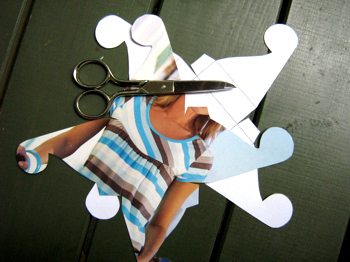
After the first box I felt like making a box from thin cardboard.
The cardboard is from the wrapping of a pair of trousers I bought and I liked the colours of the printed picture.
So I put my printed and cut template on the cardboard, copied it and cut the cardboard along the lines.


unikatissima Flower Flap Box
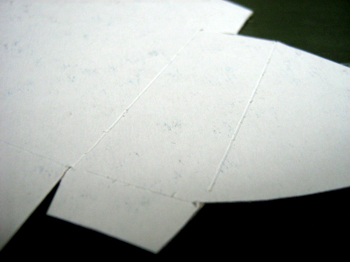
I pre-folded the folding lines to get better folds.


unikatissima Flower Flap Box
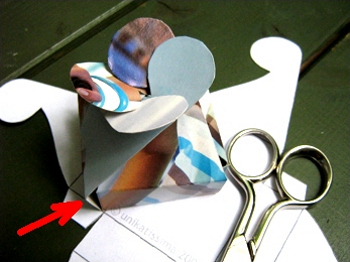
Then I simply folded the box without glueing the tags.
The red arrow shows that there originates a gap.
Depending on what you want you can leave the box at that, the tags make sure that in spite of the gaps nothing will drop ;-)


unikatissima Flower Flap Box
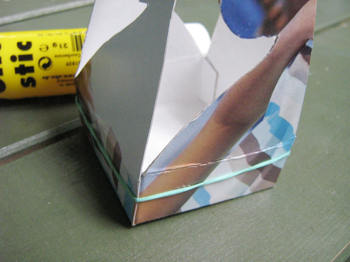
Here I glue the tags to see what happens.
The box always got apart until I fastened it with an elastic.
The glue could set this way better.


unikatissima Flower Flap Box
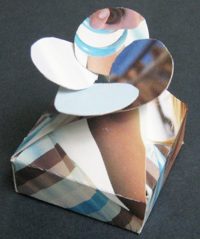
And that is my second little box.
You can see at the edges that it is a properly closed box now ;-)


Links:
Here on this site:
Instruction for first box: Pasted paper
Instruction for second box: Thin cardboard
Template to print

Stain paper with tea
Tea Staining Your Art Journal Pages
Tea Stain Paper

Making Paper Beads

unikatissima Doodled Paper Beads

After I’ve made my paper beads roller that I presented yesterday I played around with paper beads a little more.

I prefer the tube beads anyway (marginally ;-)) and after having seen the paper bead designer I thought: ‘Yes, a little bit of colour is enough, you can’t see the rest anyway.’

So I quickly made me some doodle paper beads ;-)

And that’s what you do:


unikatissima Doodled Paper Beads
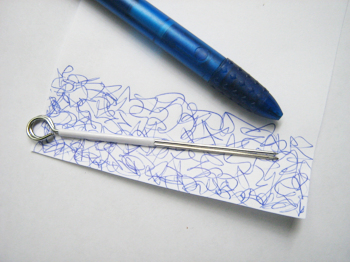
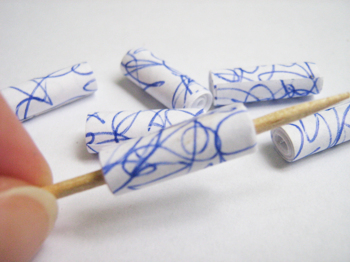
First I took two sheets of plain printer paper and simply doodled at one side with a blue ballpoint pen.


unikatissima Doodled Paper Beads
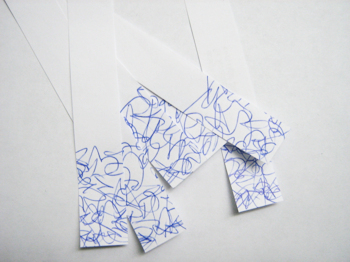
Then I cut the sheets in strips of the same width…


unikatissima Doodled Paper Beads
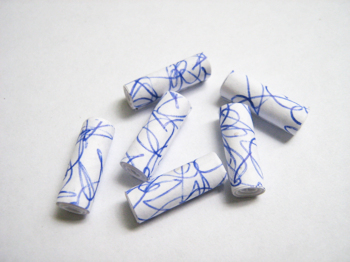
… and rolled my paper strips with my nifty paper bead roller in a wonderful short time.


unikatissima Doodled Paper Beads
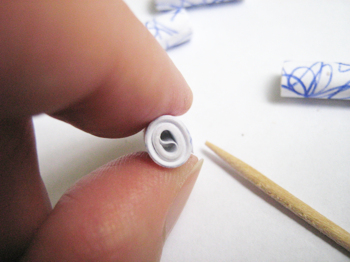
Of course the hole of the bead is split into two holes, too, because my bead roller consists of two halves.


unikatissima Doodled Paper Beads
I ‘stirred’ the hole again with a toothpick so that only one big hole remained.


unikatissima Doodled Paper Beads
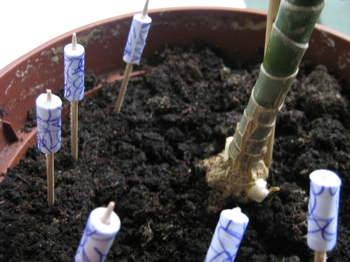
Somehow I didn’t want to use the glue excess as varnish for the beads, so I used a simple glue stick and covered the beads afterwards with medium gel. Here you can see them drying.
My potted palm got special leave on my balcony for it ;-)


unikatissima Doodled Paper Beads
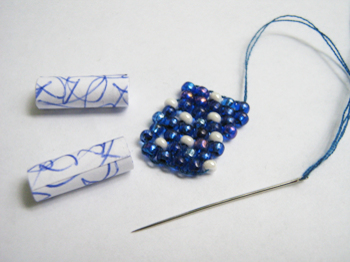
Although I find my doodled paper beads beautiful I thought that I would look boring if I string only them, therefore I made some additional easy Peyote beads.


unikatissima Doodled Paper Beads
Looks good, doesn’t it? ;-)
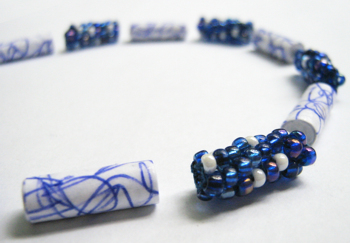
I wasn’t sure yet what I would do with my beads on this photo.


unikatissima Doodled Paper Beads
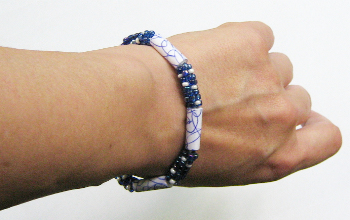
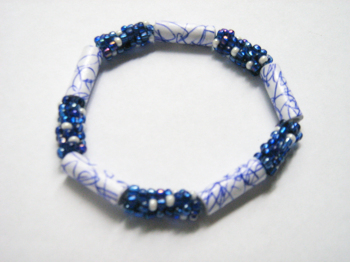
It became a bracelet in the end. I simply strung the beads on an elastic and hid the knot in a bead.


unikatissima Doodled Paper Beads
And here an ‘action shot’ ;-)
It’s not so easy to take a good photo of your own arm ;-))


After I had finished with my doodled paper beads I thought, that this was a great way to make a lot of matching paper beads from advertising flyers.


unikatissima Magazine Paper Beads
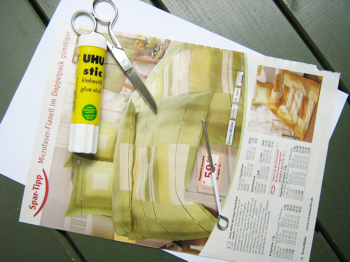
So I picked an ad with a photo of bed sheets where I liked the clour scheme.


unikatissima Magazine Paper Beads
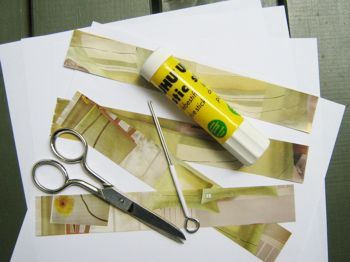
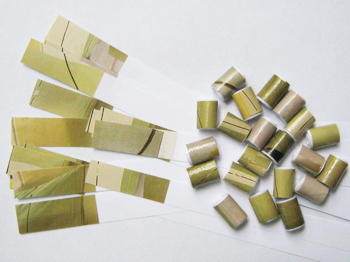
Then I measured the circumference of my doodled paper beads with a string and cut strips from the ad a little broader than necessary.


unikatissima Magazine Paper Beads
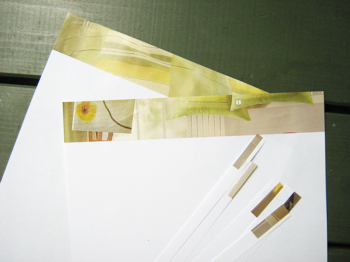
I glued the strips from the ad at one side of a plain printer paper sheet and cut the resulting papers in (in this case) 1 cm broad strips, because I wanted to have little beads.


unikatissima Magazine Paper Beads
I glued some patches from the rest of my ad on details that I didn’t like, they won’t to be seen on the bead.


unikatissima Magazine Paper Beads
Here my beads are drying on a wire because I cut about 80 paper strips and I don’t have enough toothpicks or plants for the drying process ;-)
This time I used a water-based craft glue that glues fast but dries slowly.
This is great because I could varnish my beads easily with the excess of the glue which made them shine and when my fingers eventually got sticky I could wash the glue easily away with water.


unikatissima Magazine Paper Beads
I have not yet finished, but I find my paper beads beautiful, a little bit like made from Jade.
We will see what they will become :)


Links:
Paper Bead Designer

Peyote Bead (Beaded Bead)

Here at unikatissima:
Paper Beads Roller
Entries containing the words ‘paper’ and ‘bead’

Paper Beads Roller

unikatissima Paper Bead Roller

In a sense I always found paper beads great, but in another sense it always makes (made! ;-)) such a mess, so that I didn’t often made some.
Then I found the paper bead purses (ooooh…). (The link doesn’t work no more, look instead for the Google image search result for ‘paper bead purse’.)
And on the website of the paper bead purse designer I found a video showing how to use a paper beads roller that you can buy at her website (this link doesn’t work neither, but there’s still the video).
Great idea!
She also describes very good how to apply the glue and how to use the glue excess as varnish for the bead.

A little more research found me an instruction on how to build a self-made paper beads roller.
Another great idea! ;-))

I wasn’t sure whether I want to make sooo many paper beads and additionally I thought that I don’t need no crank, so I simply put everything together and the result is my spontaneously made paper beads roller ;-)

And that’s what you do:


unikatissima Paper Bead Roller
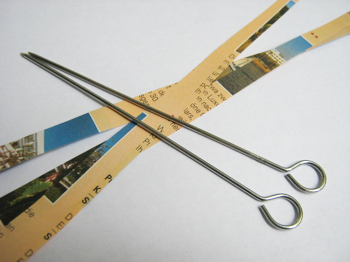
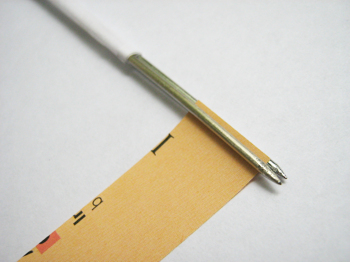
Cut your paper strips for the beads (I used a page from a travel brochure) and take two big needles, two toothpicks (they have to be smooth!) or – as I did – two little metal skewers.


unikatissima Paper Bead Roller
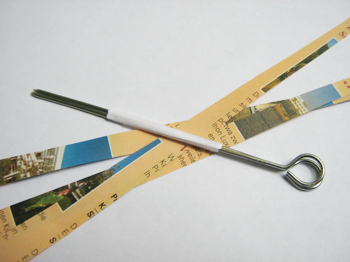
Join both needles (toothpicks, skewers…).
It would be enough to wrap some tape around, but I didn’t want to become my skewers sticky after taking away the tape, therefore I wrapped a broad strip of paper around and taped that.


unikatissima Paper Bead Roller
Slip the end of a paper strip between both skewers (if you use triangular ones, slip in the broad end) and begin to wrap on the bead.
On the photo you can see the paper strip that holds together my skewers.


unikatissima Paper Bead Roller
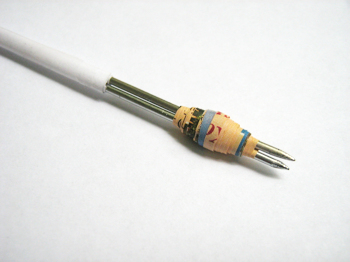
That’s how it looks shortly before you’re finished with wrapping.
You can’t see no glue on this photo because I can’t wrap with one hand and take photos with the other – at least not without dripping glue everywhere ;-)


unikatissima Paper Bead Roller
When your bead is done you can easily remove it.


unikatissima Paper Bead Roller
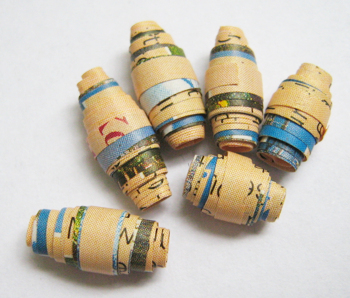
I was amazed at how fast and easy everything worked and I had much less mess than before ;-)


unikatissima Paper Bead Roller
The hole of the bead is split into two holes because my bead roller consists of two halves.


unikatissima Paper Bead Roller
I then simply ‘stirred’ the hole with a toothpick so that only one big hole remained ;-)
(By the way, the instruction for this bead is scheduled for tomorrow ;-))


Have fun wrapping paper beads! :))
and if you want to try some other bead shapes check out the Paper University.


Links:
Paper Bead Purses
The link doesn’t work no more, look instead for the Google image search result for ‘paper bead purse’.
Paper Beads Roller Video
Self-made Bead Roller (How to use a bead roller) => scroll down to ‘Hand Made Bead Roller’

Different Paper Bead Shapes (Recycled Paper Beads)

Google search result for ‘paper bead howto’
Google image search result for ‘paper bead howto’
Google search result for ‘Papierperle Anleitung’
Google image search result for ‘Papierperle Anleitung’

Here at unikatissima: Entries containing the words ‘paper’ and ‘bead’

Ladder Rings

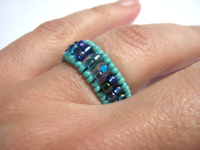
unikatissima Ladder Ring

I found the Ladder Rings where they added a link to the (free) instruction. But you have to register there and I don’t like this.
So I figured out how I would do it and that’s what I came up with (it may be that their instruction is completely different):


That’s what you do:
 

unikatissima Ladder Ring
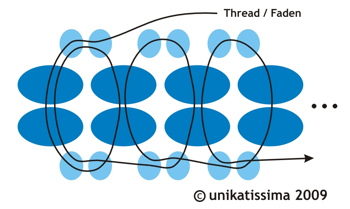
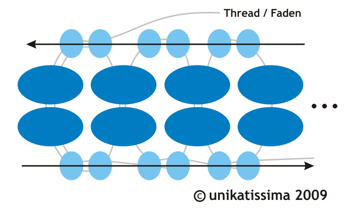
You need two sizes of beads which are to be linked as seen in the diagram.
If you’re ready it doesn’t look very good because there are really gaps between the little beads as in the diagram.


unikatissima Ladder Ring
That’s why you pull the thread once more through all little beads – the ring is finished.


unikatissima Ladder Ring Caution: The second step tightens the ring considerably.
I made my first ring much too narrow because I didn’t know that it gets smaller in the second step.
Unfortunately I can’t say how much.

At the second try I did it differently: I repeated the first step until I thought that it should be enough, then I pulled the thread through the little beads on one side and tried if the ring fits.
It didn’t, so I pulled out the thread from the little beads, repeated the first step two more times and then it was right.


Links:
Ladder Rings

Hand Knit-Weave

unikatissima Hand Knit-Weave

I discovered recently ‘knit weave’ (you can see pictures when following the links).
I like it! ;-)

Knit weave is mostly worked on knitting machines by laying a thread on the stitches. This thread is then trapped in the stitches and can be seen sometimes on the front side, sometimes on the back side of the item.
I found this interesting and thought that it should be possible to do this by hand.
I didn’t find very much (see links), therefore I’m reporting my own experience here.
Just a note: ‘knit weave’ can be translated in German by ‘Webstricken’, but when googling Webstricken you get quite different results: there are knitting needles where you can thread in an extra thread that will be worked in your item when knitting. But it looks different from ‘my’ knit weave.


That’s what you do:
In principle you carry an extra thread with you that will be laid on the front side and the back side of your work, alternately. That’s like weaving: the weft will be brought over and under.
I suggest not to let the extra thread lay on one side longer than four stitches. The float will get too long and your fingers can get caught.
Always check the extra thread tension to prevent it from hanging or contracting the knitted stitches.
You can see best what I’m talking about when checking the following examples:


unikatissima Hand Knit-Weave
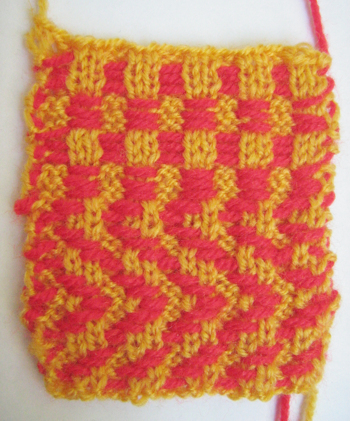
My first item.
I knitted the yellow item in a rib pattern two knit-two purl to prevent it from curling.
While knitting I carried a red thread that I always laid two stitches on the front side and two stitches on the back side of my work.
The back side looks similar.


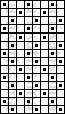
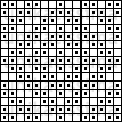
unikatissima Hand Knit-Weave Pattern unikatissima Hand Knit-Weave Pattern These are both patterns I used for my first item.
A filled square means: ‘lay the thread on the front side of your work’, an empty square means therefore ‘lay the thread on the back side of your work’.

(To download simply click on the image with the right mouse button and use something like ‘Save image as…’.)


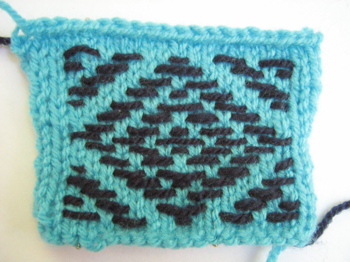
unikatissima Hand Knit-Weave
My second item: This time I used kitchener stitch and I was pleasantly surprised to see that the item nearly don’t curl when knit woven.
Note: I’ve been told that this is not the kitchener stitch but the stockinette stitch.
In the end it doesn’t matter which stitch you use (to a certain point ;-)), but I see that I have still lots to learn about the English knitting vocabulary ;-)).


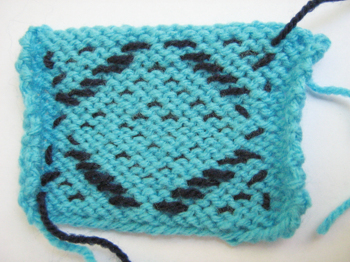
unikatissima Hand Knit-Weave
Here the back side: just as with multi-coloured knitting.


unikatissima Hand Knit-Weave Pattern That is the diamond pattern I used for my second item.
(The download works in the same way as above.)


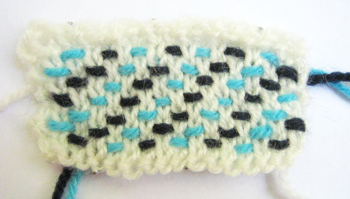
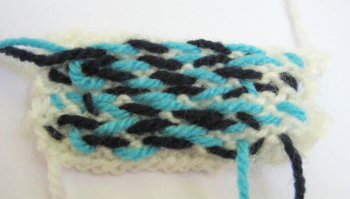
unikatissima Hand Knit-Weave
Then I wanted to know whether it works with two colours, too.
I think it does ;-))


unikatissima Hand Knit-Weave
The item gets however quite thick because of the many yarns.
Besides I’m sure that you can make the whole thing much neater ;-)


unikatissima Hand Knit-Weave Pattern So, that is the two-colour pattern.
A square filled with a filled square (eehm…) means: ‘dark blue thread on the front side of the item’, a square filled with an empty square means: ‘light blue thread on the front side of the item’, an empty square means: ‘all extra threads on the back side of the item’.


unikatissima Hand Knit-Weave
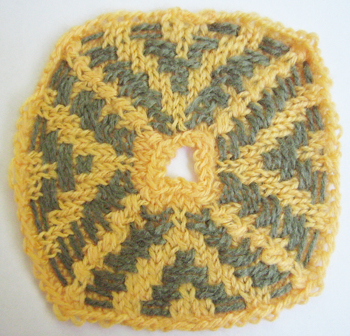
In the end I just played around with an extra: I knitted the (hmpf!) square from outside to inside in kitchener stitch by knitting three stitches together in the corners in every second row.
I carried the gray extra thread that I laid on the front side every second row shifted for one stitch.

Unfortunately I blocked the square made from acrylic yarn too hot, that ‘s why I can’t get it square anymore ;-(


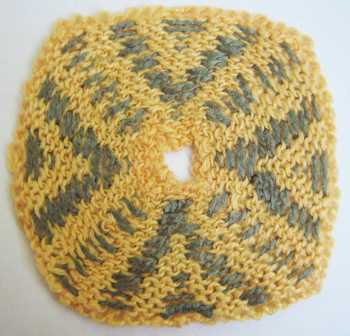
unikatissima Hand Knit-Weave
Here you can see the back side of the square.
The pattern is inverted and look also nice.


What I want to try next:

  • In the links you can find photos combining knit weave and lace knitting, I like this.
  • I want to carry a funky yarn once to see if one can still recognize the patterns.
  • I haven’t tried yet whether you can carry more than two extra threads.


Links:
Short Description ‘Knit-woven Effects’

Photos of machine knit woven pieces (with lace knitting)
Photos of machine knit woven pieces

Knit-Weave Patterns

A short movie about the technique that she uses there to weave in fur yarn => look there for ‘Hand knit-weave technique’

Meine kleine Buchkritik – My little book review: Kathleen Kinder, ‘The technique of Knitweave’) (German and English): actually I refer to the pictures because the reviewed book is about machine knit weave

Sashiko Embroidery


unikatissima Sashiko Embroidery

Actually I don’t want to talk only about Sashiko embroidery but about Sashiko embroidery on paper – I just prefer to embroider on paper ;-))

I discovered Sashiko embroidery one day when surfing the internet and found the results just beautiful!
The basic principle (as far as I understood) is that Sashiko embroidery is mostly a shape filling embroidery and the lines are worked as ‘dashed lines’ where the spaces between the dashes are about half as long as the dashes themselves (simply check the tutorials (for ‘real’ Sashiko embroidery) in the links, they explained it better).


unikatissima Sashiko Embroidery
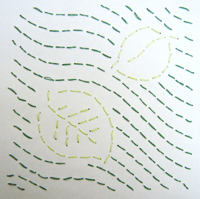
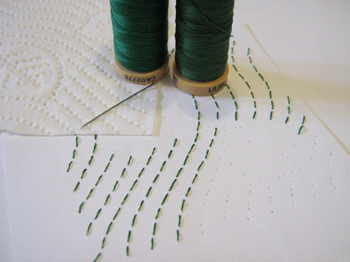
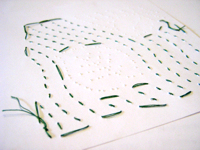
Then I saw one day that our toilet paper (top left on the picture) doesn’t only have a nice pattern but that I can use the pressure points for a Sashiko embroidery by using alternately the left and the right side of the points as needle entry points.
Therefore I trace-pricked the pattern on paper (bottom right on the picture) and embroidered it in two colours.
I find that you can’t see any more on the result that it is made by ‘cheating’ from toilet paper ;-))


unikatissima Sashiko Embroidery Here a look at the backside.
I will glue it on a card and send as a greeting card.
To people who use different toilet paper ;-))


Links:
Sashiko Tutorial
How to do Sashiko Stitching

Google image search result for ‘sashiko’