You can find many hints in internet on how to block knitted lace, I wanted to show you how I did.
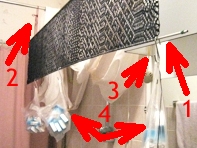
You can see the Advent calendar shawl on the picture:
- I still had two aluminium rods (1) of 5 mm diameter and 2 m length at home, which I threaded through the edge stitches.
- Then I thoroughly soaked the shawl in water and hang up the upper rod (2).
- I hang up weights (3) with S-hooks,…
- …where the weights where little plastic bags with paper tissue packages (4).
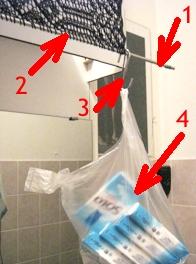
Here the details again:
- (1) is the lower rod,
- (2) are the edge stitches where I threaded the rod through,
- (3) is one of the S-hooks and
- (4) the weight: the plastic bag with the paper tissue packages.
This way both rods are pulled apart and the shawl is blocked.
But the technique isn’t perfect: I’d have needed rods for the short sides of the shawl, too, that should have been attached to the long rods, but I didn’t have the time.
That’s why the short sides of my Advent calendar shawl are slightly worn out, but it’s not soo bad.
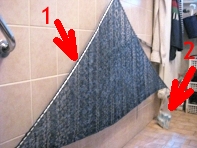
In a similar way you can do this with a triangle shawl: I threaded the same aluminium rods then above (1) through the holes I’ve knitted at the edge.
Then I added an S-hook with the weight in the last hole to really drag the points down.
I soaked everything in water and placed it on the ground.
The weight of the water drags down the center so that I didn’t need any weight there and it didn’t wear out as much as the rectangular shawl.
By the way, I covered the ground with a plastic cover because I didn’t want to wade through puddles ;-)
To see how others block their lace, simply search for blocking knit lace or stricken (spitze OR ajour OR lochmuster) spannen in German (results not so good).
Links:
Google search result for ‘blocking knit lace’
Google search result for ‘stricken (spitze OR ajour OR lochmuster) spannen’
Here at unikatissima:
Advent calendar shawl
Note: After Christmas I will offer it in just one file ;-)

 American instruction: Crochet DROPS flower to decorate a glass in “Cotton Viscose”.