Cardboard Weave II

Cardboard Weave II

While surfing I found mini or hand-held looms (see links below), which I find very interesting, because 1st I don’t have much place at home and 2nd I know that I don’t weave, I just try it once in a while ;-))
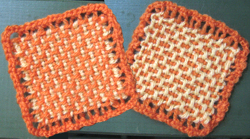
On the photo you see the front and back side of my little woven patch.
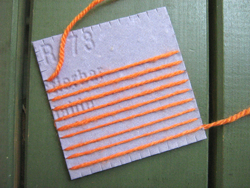
 

Cardboard Weave II I would never actually buy a loom, therefore I made me one from – guess… – yes: cardboard! ;-)
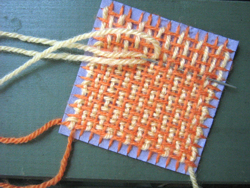
On the photo you see me threading the loom in one direction.


Cardboard Weave II
Then I thread my cardboard loom in the other direction.
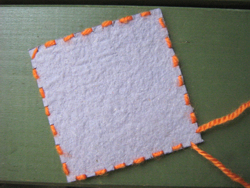
 

Cardboard Weave II That’s the way my cardboard loom looks at the back side.
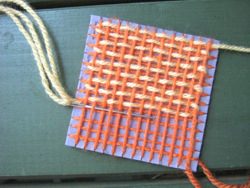
 

Cardboard Weave II Now I’m weaving in one direction.


Cardboard Weave II And here I’m weaving in the other direction.
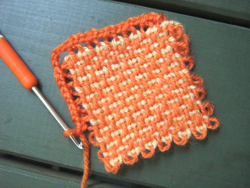
 

Cardboard Weave II After having finished with weaving I crochet an edging to neaten the edge.

The first photo shows back and front side of the finished little piece.


Links:
At Weavettes:
How to weave on a mini loom (English) (via knitting-and.com)

The original site doesn’t exist any more and is now available through webarchive:
At Weavettes:
How to weave on a mini loom (English) (via knitting-and.com)

At eLoomaNation: Big Ideas from Little Looms:
Get ideas what to do with your patches

Get basic woman measurement charts for clothing patterns at the website of Jessica Tromp just as for the Clothes From Crocheted Medaillons
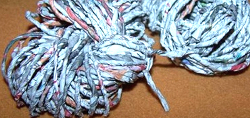
Crazy Daisies II

Crazy Daisies Scarf

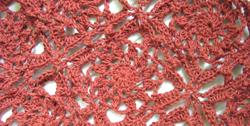
I continued to play around with the Crazy Daisies. It is so much fun and I’m working on a Crazy Daisy Scarf. On the photo you see my scarf.


Crazy Daisies II One thing I found out is that I love the little flowers much more without any edging. Therefore I’m joining them while working.
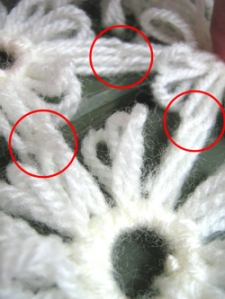
I’m measuring the yarn and wind the daisy. In doing so I’m pulling the thread immediately through the loops of the previous daisies using a blunt tapestry needle.
It takes a little longer, but this way I don’t have to assemble later and avoid the problem of hiding the ends.


Crazy Daisies II The other thing I played around with is another cardboard loom. In my first Crazy Daisy entry I used a cardboard version of the ice-cream-lid-loom.
Later I found other daisy looms and created my cardboard version of it. It works very well.


Crazy Daisies II
My cardboard loom consists of 2 cardboard disks. I taped them together and put 12 pins between both disks. I can then wind a daisy and when finished I pull the pins out. For the next daisy I put the pins back in my cardboard loom.
Note: I found out, that the disks must be very tightly taped, otherwise the pins fall out.
I always use the same pin holes and this way the tape won’t be damaged. I used my well taped cardboard loom over and over and don’t have any problems with the pins.
This way I can make my loom on the spur of the moment in the shape and size I need at the moment. I also tried a square one and the square daisies looked also nice.


Links:
unikatissima’s Crazy Daisies

Butterfly Loom

Butterfly Loom

At the website of Knitting-and.com where I found the Crazy Daisies I also found the Butterfly Loom.
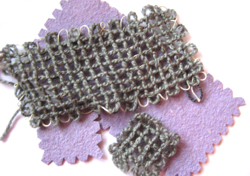
As always I didn’t want to buy something without knowing if I will use it ever again and cut my butterfly loom in different sizes from cardboard as you can see on the photo.
It worked out very well, but although I’m always coming back to different kinds of weave I think I’d never be patient enough to actually create something with this technique. It’s a pity.
;-)


Links:
Knitting-and.com: Butterfly Loom

via Knitting-and.com at The Butterfly Loom:
Patterns for the Butterfly Loom
Joining Butterfly Loom Motifs

You can also find a description, faq’s and a gallery of items made with their Butterfly Loom

Here at unikatissima:
Crazy Daisies

Ganutell

Ganutell

Via craftster.org I found another craft, I’ve never heard about: Ganutell.
It makes me think of my Starburst card ;-)
Originally they made flowers with this technique, but it looks great as earrings as seen at this craftster discussion thread.
I have to face it: it is another technique on my (long, long) what-I-really-have-to-try-list ;-))


Links:
Ganutell

Discussion thread at craftster.org: How to make these ‘woven’ earrings?

Here at unikatissima:
Starburst Card

Clothespin bobbins

Clothespin bobbins

Once I found a really good idea on how to make inexpensive bobbins from clothespins.
Later I found more very good ideas at Gabriela Marková’s Kumihimo blog, all entries labelled with ‘Equipment’.
You can use those bobbins very good when making you own Kumihimo cord.

Links:
Learn Intarsia Knitting (the clothespin bobbins are mentioned there)

At Gabriela Marková’s Kumihimo blog:
All entries labelled with ‘Equipment’ (English)

Kumihimo Edo Yatsu

Kumihimo Edo Yatsu

I found recently the blog of Gabriela Marková. I’m very glad about, because her (German) book ‘Kumihimo – Flechtkunst aus Japan’ ‘Kumihimo – Flechtkunst aus Japan’ was such a help for me to learn Kumihimo.
In this book she describes not only different braids, but she always encourages the reader to play around, to try new braids, colour combinations and so forth.
It really was the right book for me ;-)
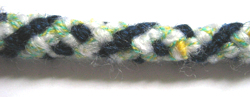
On the photo you see one of my braids, and I’m almost sure, that it is a Edo Yatsu braid ;-)
If you want to give the Edo Yatsu braid a try, check Gabriela Marková’s blog entry.

Links:
Kumihimo blog of Gabriela Marková
Kumihimo Edo Yatsu braid

The link isn’t available no more.
Gabriela Marková’s German book ‘Kumihimo – Flechtkunst aus Japan’ (English)
At Amazon.de:
Gabriela Marková’s German book ‘Kumihimo – Flechtkunst aus Japan’

Kumihimo here at : unikatissima :
Kumihimo beads here at : unikatissima :

Clothes From Crocheted Medaillons

Clothes From Crocheted Medaillons

Once I found the website of Jessica Tromp.
Hours later I regained consciousness ;-))

It is difficult to say, what I love best, but in the end I decided, that it must be the crochet patterns for/from square medaillons. But make sure to check all the other crochet patterns also (look for ‘crochet PATTERNS’ in the left navigation bar of her website).

Best of all, she designed a gazillion of clothes and each and every one for different women sizes!
In addition she offers basic woman measurement charts for clothing patterns.

I simply don’t find the right words for this site ;-))


Links:
Jessica Tromp:
Crochet patterns for/from square medaillons
Basic woman measurement charts for clothing patterns

Leftover Needlework

Leftover Needlework

I have a lot of yarn and thread rests, some of them quite short and I had no idea, what to do with them (except Freeform needlework as a matter of course ;-)).
And then one day I found an article about the ‘Magic ball’ an article about the ‘Magic ball’ and decided that this is it ;-)
In the bottom line it’s nothing else then taking your short threads and knotting them together (with a weaver’s knot e.g.) to get a long enough thread to knit or crochet or what ever you want to do.
On the photo you see three tests I did: On the item above I simply knotted different strings into a long thread and crocheted. It were quite short strings.
For the item below left I took two skeins of yarn, one green and one rose. I knitted with two threads and knotted them so, that I began working with 2 greens, then a green and a rose, then 2 rose, a green and a rose again and back to 2 greens. That way I got a kind of blend between the two colours.
The item below right is made in the same way, but with one light green and one dark green.

I’m sure that I will get back to this technique again.


Links:
Make your own magic using knotted yarn leftovers: the link isn’t available no more.

At unikatissima’s:
Freeform Needlework
Weaver’s Knot

Kumihimo Beads

Kumihimo Beads - Kumihimo Perlen

This Thursday’s 2nd challenge Beaded Beauties gave me the opportunity to do something I wanted to do for a long time: making Kumihimo beads.
Kumihimo is a Japanese technique to braid beautiful cords, but then: what do I do with the cord? It’s way too beautiful (and too labour-intensive! ;-)) to be used as a shoelace for instance.
I thought that it would make wonderful beads, but usually the braids are finished by wrapping some string around the braid and such beads would be much too long.


Kumihimo Beads - Kumihimo Perlen Therefore I figured out how to make my own Kumihimo beads.
The technique is far from perfect and I hope that you will try it and give suggestions to enhance the technique.

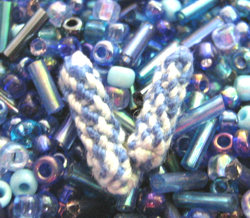
On the first two photos you see Kumihimo beads I made, the blue ones with cotton thread and the black and white ones with acrylic yarn.
All beads were made with 4 light and 4 dark coloured yarns, but I changed the initial positions on my cardboard Kumihimo disk.
You see at the surrounding seed beads how tiny my Kumihimo beads are.


Kumihimo Beads - Kumihimo Perlen What to do:
Make your Kumihimo cord. I worked about 20 rounds.
When finished, pull all threads into the bead.

And that’s where the problem lies:
If you make the Kumihimo cord ‘the normal way’ you won’t have enough place into the bead to pull all 16 threads in (8 threads at each side of the bead).
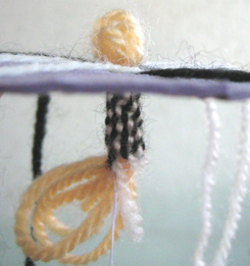
I tried different techniques to ‘reserve’ a place for the thick bunch of threads. The best one I found was making a bundle of 8 threads of the same gauge and using it as ‘filler’, that means, working around them (see third photo).


Kumihimo Beads - Kumihimo Perlen The Kumihimo beads are from fabric and can be stitched however you want. On this photo I surrounded my Kumihimo bead by seed beads and made a kind of Freeform Peyote Pendant.


Links:
This Thursday’s 2nd challenge Beaded Beauties

unikatissima’s Kumihimo How-to
unikatissima’s Freeform Peyote How-to