Recycled Gift Tags

unikatissima Recycled Gift Tags

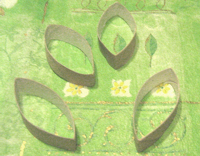
The gift tags on the photo aren’t ready yet: I simply can’t decide with which yarn I should wrap them.

But I find the idea really great: flatten the cardboard tube, cut it in strips and wrap the pieces with yarn.
I think that it could look beautiful, too, when wrapped in a piece of beautiful polymer clay and worn as necklace, earring or pin.
Hm.

When reading the instructions for the gift tags I had to think somehow at the surprise ball gifts ;-)

But she had other ideas, too, about what to make with these paper shapes, namely a cute tealight and an interesting lamp decoration.

I presented before entries about recycled cardboard tubes here in this blog, namely the beaded amulet bag, the plaster photo holder and the knitting loom from a plastic bottle.
But there the cardboard tube was ‘only’ a tool.


Links:
recycling project no. 19 – yarn gift tag

recycle project no. 12 – tealight decoration
recycle project no. 16 – hurricane cover

Here at unikatissima:
Surprise Ball Gifts
Beaded Amulet Bag
Plaster Photo Holder
Knitting Loom from Plastic Bottle

Knit and Felt a Knot Bracelet

resurrection fern Knit-Felted Bangle Bracelet

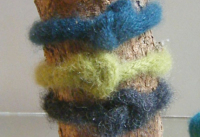
These knit-felted knot bracelets are cute, aren’t they?

I think that you can surely make them with filled I-cords, too, then they are more firm (only take care about what happens to the filling when felting with hot water!). In principle it’s what Sue suggested in her comment.

Or the whole thing may be even possible with a buttoned I-cord bracelet, where the original was made with beads. When using glass buttons or glass beads it should be no problem to felt it (but I haven’t tried it yet).

Possibly you can even use filled and felted I-cords to make a fabric bowl from?!

And when you felt some of the cords of the cute spaghetti scrap scarf it surely looks great, too.

Oof, soo many ideas ;-))


Links:
This Is Knot a Bracelet : A Tutorial to Knit and Felt a Bangle Bracelet

Here at unikatissima:
Actinia – here I put my own instruction on how to make an I-cord in the PDF file
Clothesline Knitting or Filled I-cord
Buttoned I-cord Bracelet
Clothesline Sewing – A Fabric Bowl
Spaghetti Scrap Scarf
Sues comment

Chevron Takadai Braid

braidweaver Chevron Takadai Braid

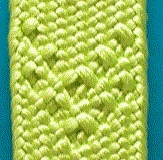
Since a long time I take a look at the Takadai braids instructions from time to time – I find them sooo beautiful!
They resemble the Kumihimo braid patterns, but the cords become flat, not round.

But I don’t have any chance to try this because I don’t have the room to place a braiding loom somewhere here.
And I think that I would lose interest very soon.
But anyhow…
;-)


Links:
Instruction for the chevron Takadai braid (Creating Pattern with Texture)
How Taka Dai Braids are Made
Description of the braiding loom (Parts of the Taka Dai)

Here at unikatissima: Entries with the tag ‘Kumihimo’

Celtic Circle Knot

Free-Macrame-Patterns_com - Celtic Circle Knot

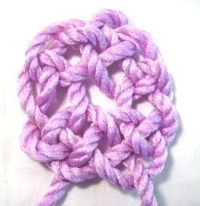
I find this Celtic Circle Knot really beautiful and imagine it depending on the used yarn as an ornament on a card, a pin or a hair decoration.
But I can’t show my own photo yet because my fingers were up until now much too clumsy for it ;-))

And when I have worked it out I can possibly even design my own Celtic Knot ;-)


Links:
Celtic Circle Knot

Here at unikatissima: Designing a Celtic Knot

Crocheted Beads

flickr BeaG Crocheted Beads

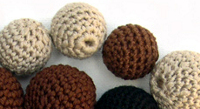
I have found this tutorial for crocheted wooden beads before and then I lost it – I was quite unhappy!
But now I found it back (somewhere else!) and I’m feeling fine again ;-))

I haven’t tried it yet but I would like to make them with coloured yarns because you can make so wonderful hues with.


Links:
Crocheted Beads (Pattern for Crocheted Beads)

Here at unikatissima: Coloured Yarns

Card Holder

Recyclart Card Holder

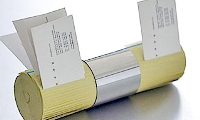
Wow, an idea again that I really appreciate: take a phone book, roll it up and fix it with a ring of a nature what-so-ever and done is the card holder!

The silver coloured ring looks quite good, but I imagine that it would look as good when you wrap your card holder with wire, plastic, beautiful yarns or fabrics or when you slip a poymer clay ring over, the only thing to make sure is that you fix everything well.
And in place of the Yellow Pages you can use as well coloured ads or paper – neatly stacked – or books where you removed the cover.


Links:
Card Holder (Reusing Yellow pages) – they’re linking to another website but I didn’t find the Card Holder on the other web page

Here at unikatissima:
Entries with the tag ‘ring’
Entries with the tag ‘wire’
Entries with the tag ‘plastic’
Entries with the tag ‘books’

Knitted Plaster Impregnated Bandage and more

Fan My Flame Knitted Plaster Impregnated Bandage and more

Isn’t this a great idea?
A friend sent me the link to the blog where they knit with several ‘unorthodox’ materials – it’s worth a try, I find ;-)
Perhaps crocheting, too!?

By the way, you can knit with polymer clay, too, but unfortunately I didn’t find back the links except for some photos.


Links:
Knitted Plaster Impregnated Bandage and more (Knitting… not as you know it!)
Photos of knitted polymer clay

Fabric Scrap Scarf

craftstylish Fabric Scrap Scarf

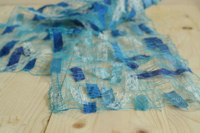
Again a scarf from scraps ;-)
But this time it’s not only about scraps nor scarves: It’s about this technique, where you arrange fabric pieces and/or yarns on water-soluble sheet, where you make it ‘unslippable’ by spraying it with fabric glue where necessary, where you cover it with water-soluble sheet again and then sew more or less wildly in all directions to connect all elements with each other.
After rinsing it (thoroughly!) you get a more or less delicate fabric that you can use as scarf like on the photo, but you can also make a top top top or a one-of-a-kind vest one-of-a-kind vest poncho from.

There is even a book that shows how you can mix this technique with felting.

I really must do this once ;-)


Links:

Here at unikatissima:


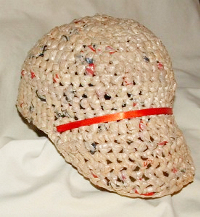
Recycled Plastic Baseball Cap

My Recycled Bags Recycled Plastic Baseball Cap

I presented bags/purses/totes made from plastic bags already (see links below), but I like a base cap from crocheted plastic bags very much, too.
Just the thing for summer :)


Links:
Recycled Plastic Baseball Cap

Here at unikatissima: bags/purses/totes made from plastic bags


2 Techniques – 1 Cord

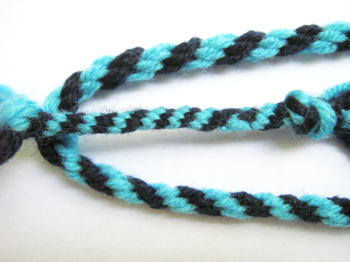
unikatissima Fingerloop Kumihimo Cord

Recently somebody showed me a simple yet beautiful finger loop pattern.
At home I tried it directly again, it is the outer cord (above and below), I braided it first to the left and then to the right.

Then I thought that I worked such a pattern in Kumihimo already, but the one I made worked a little different.
Therefore I transcribed the new finger loop pattern to a Kumihimo pattern (the middle cord on the photo).
The Kumihimo cord became much sturdier because I used quite a heavy weight.

Both are braidung techniques and I reckon that every finger loop pattern can be ‘translated’ to a Kumihimo pattern but surely not the other way round.

Afterwards I did some research and found that ‘my finger loop pattern’ has been described on the pattern page of the Fingerloop Braids Website as ‘A lace bend rounde of 8 bowes — c. 1475’ (viz. it is done with 8 loops in place of 6 loops in my case) – but I never understood the notation ;-))

Here I show you how I made the finger loop cord and the Kumihimo cord, you had perhaps problems with the notation, too ;-)


Finger loop cord

Cut 6 threads of the same length and elasticity and lay them in half to form loops.
Make 3 threads per colour (here dark blue and turquoise).
Knot the open sides together and fix them somewhere to be able to braid with the loops (you can find more detailed instructions in the links of my entry about finger loop).
 

unikatissima Fingerloop Kumihimo Cord
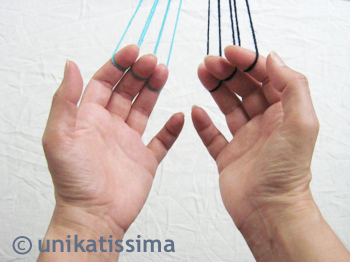
Take the loops of one colour on the index, middle finger and ring finger of one hand and those of the other colour on the corresponding fingers of the left hand.
Here I took the turquoise loops on the left and the dark blue loops on the right hand.
 

unikatissima Fingerloop Kumihimo Cord
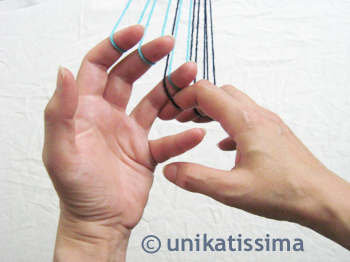
First swap the loops of the right index and the left ring finger.

To do this lay the loop of the right index behind the loop of the left ring finger…
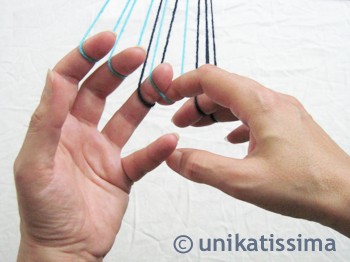
 

unikatissima Fingerloop Kumihimo Cord
…and take then the loop from the left ring finger on the right index.
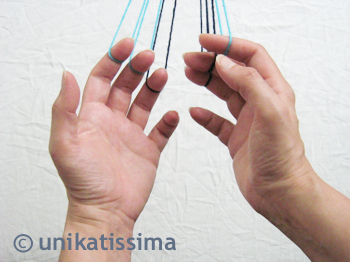
 

unikatissima Fingerloop Kumihimo Cord
You have now on the left hand two turquoise loops (on the index and the middlefinger) and a dark blue loop (on the ring finger) and on the right hand one turquoise loop (on the index) and two dark blue loops (on the middle and the ring finger).

Note: I didn’t take a photo of it, but after every swap open your arms wide to tighten the braid and make it sturdier.
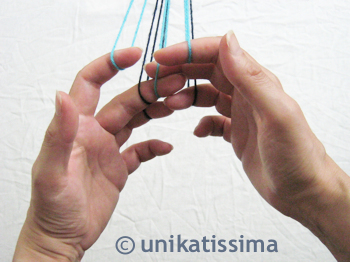
 

unikatissima Fingerloop Kumihimo Cord
Next swap the loops of both middle fingers in the same way.
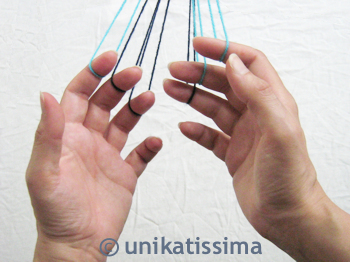
 

unikatissima Fingerloop Kumihimo Cord
You have now on the left hand one turquoise and two dark blue loops and on the right hand the other way round.
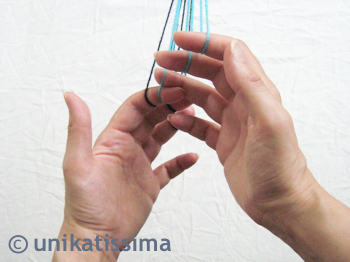
 

unikatissima Fingerloop Kumihimo Cord
For now the last step is the swap of the loops of the right ring finger and the left index.
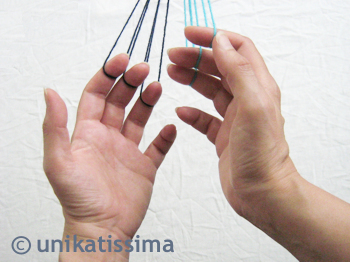
 

unikatissima Fingerloop Kumihimo Cord
Now you have all three turquoise loops on the right hand and the dark blue loops on the left hand.

That’s been the first half of the steps to do.
Repeat all steps (index right-ring finger left-swap, middle finger-swap, ring finger right-index left-swap) to bring back the turquoise loops to the left hand and the dark blue loops to the right hand, then you have braid a full round.

Repeat the steps until your cord is of desired length.


Kumihimo cord

Cut here too threads of the same length and elasticity, but this time cut 6 threads of one colour (here turquoise) and 6 in another (here dark blue).
I made the cord on my cardboard marudai, but it was no fun at all because you have to re-lay the threads for this pattern to their appropriate places at every braid.
At least by now is the moment to ‘construct’ a marudai (links to self-made marudai in my Kumihimo entry).
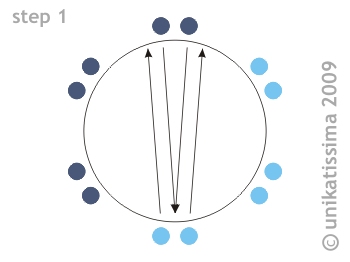
 

unikatissima Fingerloop Kumihimo Cord
Sort your threads as shown in the graphic.
Lay the upper dark blue thread pair between the threads of the lower turquoise thread pair and then lay both turquoise threads where the dark blue ones have been.
Push together the thread pairs to clearly separate them from each other.
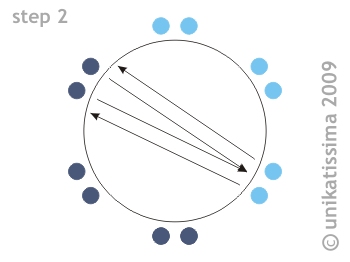
 

unikatissima Fingerloop Kumihimo Cord
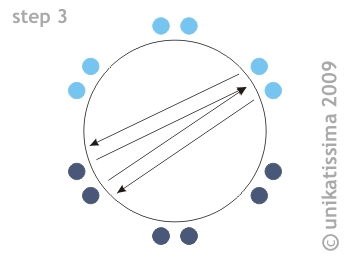
In the second step you do the same with the dark blue thread pair top left and the turquoise thread pair down right.
Here again push together the thread pairs neatly.
 

unikatissima Fingerloop Kumihimo Cord
In the third step you do the same with the dark blue thread pair down left and the turquoise thread pair top right.

That was the first half of the steps and here, too, the steps must be repeated to get back to the original colour distribution:
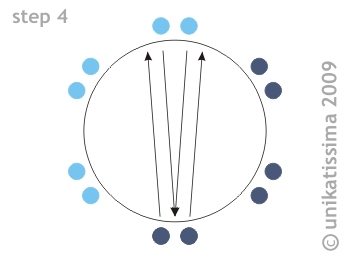
 

unikatissima Fingerloop Kumihimo Cord
Lay the upper turquoise thread pair between the threads of the lower dark blue thread pair and then lay both dark blue threads where the turquoise ones have been.
Always push together the thread pairs neatly.
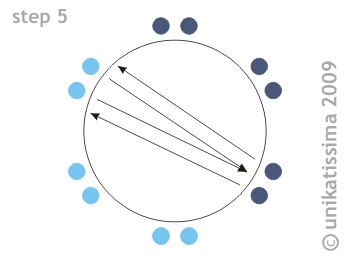
 

unikatissima Fingerloop Kumihimo Cord
In the fifth step do the same with the turquoise thread pair top left and the dark blue thread pair down right.
Here again push together the thread pairs neatly.
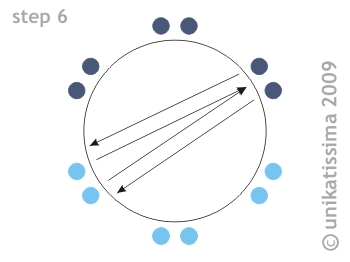
 

unikatissima Fingerloop Kumihimo Cord
In the last step of this round you do the same with the turquoise thread pair down left and the dark blue thread pair top right.
As always push together the thread pairs neatly.

You have finished the first round now, repeat all six steps until your cord has the desired length.

Have fun with the comparison of the two techniques finger loop and Kumihimo and make some beautiful cords :)


Links:
Marca brandenburgensis anno domini 1260 – that’s where the woman came from who showed me the pattern

Fingerloop Braids Website: Fingerloop Braid Patterns
and there:
the finger loop pattern that I presented here, but with 8 loops (‘A lace bend rounde of 8 bowes — c. 1475’)

Here at unikatissima:
Finger loop
for more detailed instructions see there the links

Kumihimo
   for the construction of a self-made marudai see there the links
   my template for a cardboard marudai

On this page:
Instruction for finger loop cord
Instruction for Kumihimo cord