Card with Paper Ornament

unikatissima Card with Paper Ornament

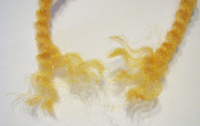
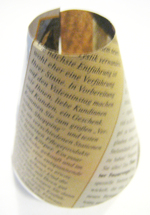
I found the umpteenth instruction on how to cut a snowflake from paper, but this time the snowflake looked so much more beautiful than usually.
I made immediately a card with non winterly coloured advertising junk mail paper :)


Links:
Fidgety Fingers: Magazine Manifesto – Paper Snow

Here at unikatissima: Kirigami Flower

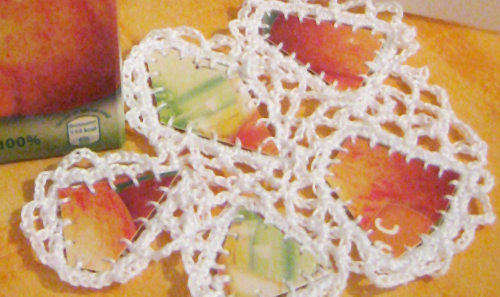
Beverage Carton Crochet

(Click photo to enlarge)
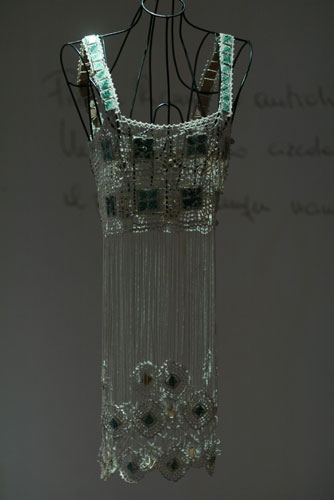
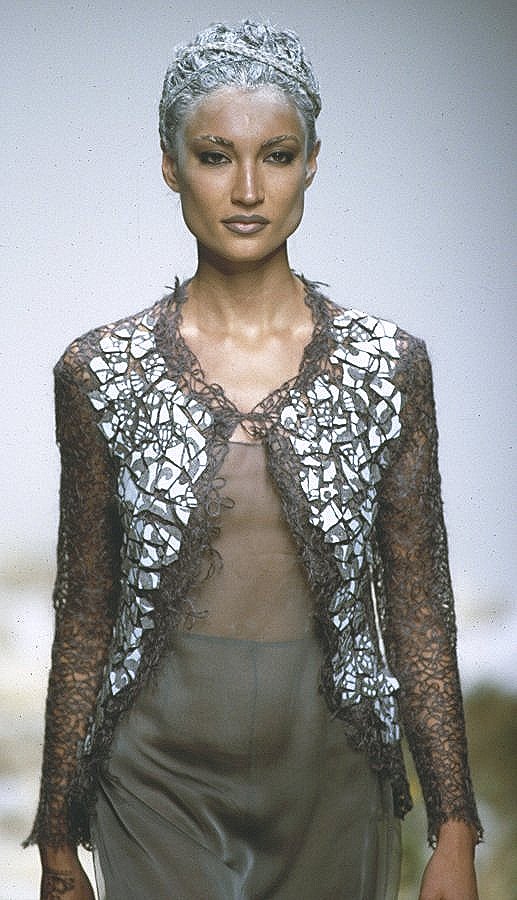
Once I’ve seen a fashion photo where I’ve been really impressed by the garment.
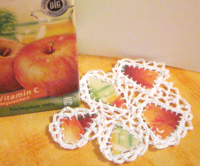
Recently, when I drank my apple juice, I thought: ‘Yes, that’s the right material in the right colour for this!’


Therefore I figured out how to make it.

And that’s what you do:

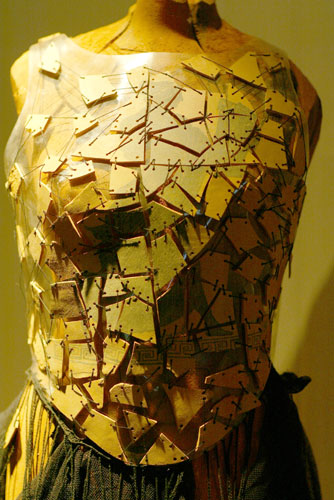
First cut the (washed! ;-)) beverage carton in pieces and, if you like, you can arrange the pieces in a pattern that suits you best (best done on a stiff pad, then you can carry it away carefully, if necessary).

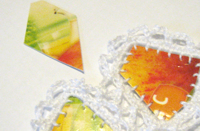
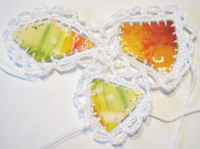
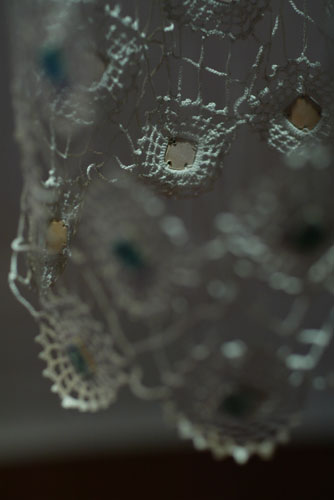
I cut my pieces just as I liked to (there is another garment), but regular shapes, square e.g. are not bad either. They were used in yet another garment (here a detail photo).


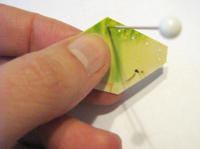
I didn’t arrange anything and on this photo I’m checking whether the piece fits at this place.


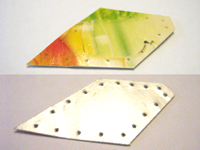
Subsequently prick holes into the cardboard. Try to get a regular spacing between the holes.

Please note that the holes may not be placed too closely to the edge!
I had to throw away some of my snippets because the thread ripped the hole.


That’s how my snippet looked like after the piercing from both sides.
The cardboard has a nice silver coloured internal coating which makes also the backside look good.


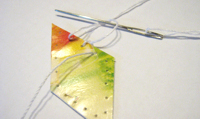
Afterwards I took my pierced snippet and surrounded it using a tapestry needle with button hole stitches with cotton thread.


The surrounding is finished.

I worked quite loosely to 1. get on easier with the crochet (see next step) and 2. keep my snippet in shape.


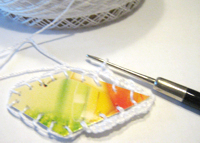
Afterwards I crocheted single crochet stitches single crochet stitches around the surrounding thread with the same thread.
Mostly I crocheted 2 single crochet stitches, sometimes even 3.
At the corners I crocheted 1 to 2 chain stitches chain stitches between the single crochets.


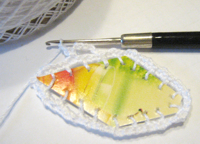
I then worked chains chains of about 5 stitches into the single crochets.


I joined the chains chains with the chains of the already finished item immediately when crocheting.


That’s what I’ve done until now.
I can imagine making a sommer vest from it, a belt or the top flap of a cute purse.
But I haven’t decided yet ;-))


Links:
My inspiration at Marella Ferrera Alta Moda:
Fall/Winter 98/99 – L’Isola dei Ciclopi
Fall/Winter 03/04 – Isola di Terracotta
Fall/Winter 03/04 – Isola di Ceramica
Fall/Winter 03/04 – Isola di Ceramica – Detail

Embroidery stitches:
Button hole stitch instruction (English)
Button hole stitch instruction (German)

Crochet stitches:
Chain (English)
The original site doesn’t exist any more and is now available through webarchive:
Chain (English)
Chain (German)

Single crochet (English)
The original site doesn’t exist any more and is now available through webarchive:
Single crochet (English)
Single crochet (German)

Here at unikatissima:
Crochet Joining
Clothes From Crocheted Medaillons

Concerning unikatissima

lemonade_award


Lemonade Award
One month ago Kokopelli nominated me already for the ‘Lemonade award for attitude and gratitude’.
Once again thank you so much, I’m really proud of it!

My entry has been delayed because I thought over and over again to whom I should give the award.
As result of my thinking I reached the decision that I can’t give it further as expected:
I’m presenting here every day instructions, many are published on blogs.
And I think that every single author who bothers to write a blog entry with his or her own instruction deserves the award already!
Thus I want to thank you all out there who provide tutorials just for the fun of it for your attitude (for the award) and for your generosity (for my part ;-))!

However I want to nominate a blog for the ‘Lemonade award for attitude and gratitude’, but not for the tutorials which are the subject of unikatissima, but because Leslie stands up for peace between Israel and Palestine with tireless dedication: The TikkunTree Project.
Perhaps some people like to participate in the project (guidelines of project) with a leaf or a dove.


Anniversary
Well, there’s something else to tell: ‘unikatissima’s compilation of tutorials’ is one year old today!
Last February I startet with the Cloche style hat and the Recycled Card Pillow Box.
It’s sheer lunacy!
;-)


Links:
Kokopelli

The TikkunTree Project
Guidelines of The TikkunTree Project

Here at unikatissima: The beginning ;-)

Floating Paper

unikatissima Floating Paper

Once I found the instruction on how to preserve leaves with beeswax. This way you can make the leaves for float on water.
I really liked the idea, but it is winter now and I thought that you can do the same with paper, similar to the beeswax collage.
Then I thought further and found out, that paper floats without wax also (goes muuuuch swifter! ;-))).

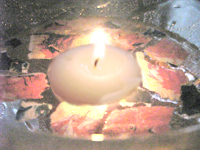
On the first photo you see a glass bowl with a simple tea light, the paper snippets are from some advertising junk mail.


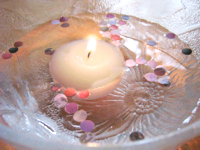
unikatissima Floating Paper For this photo I thought even further (which wasn’t easy ;-)) and spread on some confetti from the hole puncher.
I like it!


The only problem was the disposal when I wanted to throw away the confetti. I couldn’t fish them out without problems. Therefore I put a piece of tissue paper onto the gutter of my kitchen sink so that no confetti could pass through, and poured slowly the bowl on the tissue paper (if you pour too fast the tissue paper can slip). The water went through and the confetti assembled onto the tissue paper, so that I simply had to throw away the tissue paper with the confetti.


Links:
Preserving Leaves with Beeswax for Floating on Water

Here at unikatissima: Beeswax Collage

Self-made Cookie Cutters

unikatissima Self-made Cookie Cutters

Fancy some camel cookies? ;-)
I found the instruction great, especially because you can make all sorts of shapes.
For me, a simple flower is enough – hoping that spring will come swifter ;-)
But I haven’t begun yet…
By the way, I assume that you can use the cookie cutters for needle felting, too.


Links:
Make your own cookie cutter from clip-art and a foil pan
via Inhabitat » GREEN GIFT GUIDE: Make Your Own DIY Gifts
via Junk Mail Gems – DIY Christmas Gifts from Inhabitat

Here at unikatissima: Needle felting with cookie cutters

Constructing a Cone

unikatissima Example Cone

Addendum: This entry is a little longish, if you only want to get the formula, check out the entry ‘Online Cone Calculator’.

Many crafters reach somewhen a point when they need a template for a truncated cone, be it to make cone-shaped lamp shades from patterned vellum, be it for a part of a clown costume for the child, a template for a piece of jewelry from metal or polymer clay or to make a papermaché vase.
I think that most then have a clear idea about the upper and bottom diameter and the height of the cone.

 

unikatissima Possible Cone Templates
Additionally we know then that the template for the cone must be in a similar shape than one of those besides.
But how to get from the height and the diameters to the template that really makes the desired cone?

I recently pondered on this question and found math central.
There you can ask questions and check the answers to questions already put.
There are several answers to the topic ‘cone’ (simply enter cone’ into the search box) and I tried to compile from the answers a really simple instruction on how to construct cones.

It seems to be a little complicated when reading it first, but if you strictly follow the instructions, it isn’t hard. Admittedly most of us will need a calculator, because we will need later the square root of a value.
I interspersed some basic knowledge in between, because I had to re-collect tediously everything I have learned ages ago and I have completely forgotten ;-)
And I tagged the actual formulas with a at the beginning.

Have fun with it!


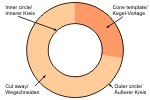
unikatissima Cone Construction Parts (Click picture to enlarge)
First of all: what does a cone template consists of?
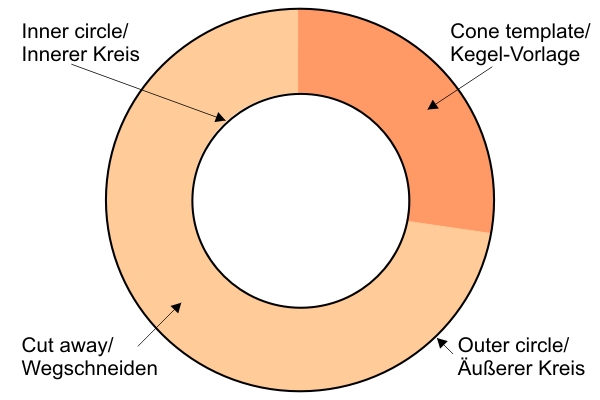
On the picture on the left you see, that our template consists of an outer and an inner circle and (light orange) a piece that we have to cut away.

First we will fix the sizes of our circles and later how much we have to cut away.
To this end we first identify the diameters of both of our circles for our cone template.
 

unikatissima Cone Construction
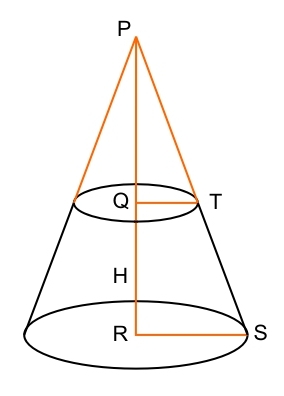
If you look at the diagram (I’ve been geared to a diagram of math central) you see, that both distances PT and PS equate the half of the diameters of our both circles from above.
(If you haven’t understand this, it doesn’t matter, simply go on.)
Therefore we will calculate PT and PS.

We will call the height H, the diameter at the top DiaT and the diameter at the bottom DiaB.
We need the desired radiuses for the formula.
That’s easy because the radius is exactly the half of the desired diameter.
Let’s call the radius at the top Rt and at the bottom Rb.


Let’s see a concrete example: our cone (that’s the one from the photo at the top) should have a height of 7cm, a diameter at the top of 3cm and a diameter at the bottom of 7cm.
Caution: All units must always be the same: they are all mm, or cm or m ;-)

H = QR = 7
DiaT = 3
DiaB = 7

Because a radius always equals the half of a diameter, we know additionally:
Rt = QT = 1,5
Rb = RS = 3,5

Now we need the distances PQ and PR that we must calculate (I found the formula in an answer of math central):
PQ = Rt * H / (Rb – Rt)
This is in our example PQ = 1,5 * 7 / (3,5 – 1,5) = 5,25
PR = PQ + H
This is in our example PR = 5,25 + 7 = 12,25

The formulas for PT and PS are as follows:
PT = sqrt(PQ2 + QT2) = sqrt((PQ * PQ) + (QT * QT))
PS = sqrt(PR2 + RS2) = sqrt((PR * PR) + (RS * RS))
Note: ‘sqrt’ means ‘square root’ (symbol: ).
Personally I don’t know how to extract a root (except for 9 perhaps ;-))), but every calculator provides this function and all computers have a calculator (somewhere!) ;-))

Let’s continue our example:
PT = sqrt((5,25 * 5,25) + (1,5 * 1,5)) = sqrt(27,5625 + 2,25) = sqrt(29,8125) = 5,5
PS = sqrt((12,25 * 12,25) + (3,5 * 3,5)) = sqrt(150,0625 + 12,25) = sqrt(162,3125) = 12,7
Note: In our example one decimal place is fully satisfying, and I’m rounding off up to 5 and up above 5.

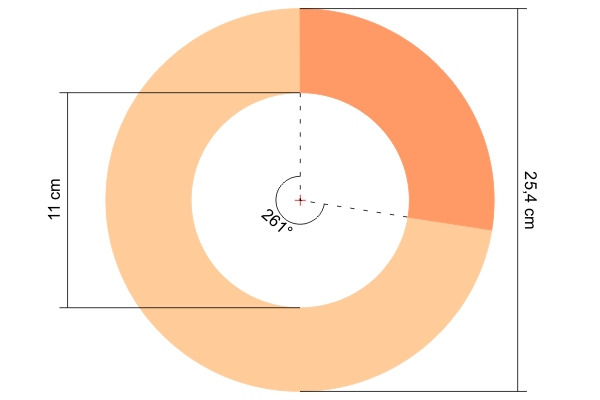
Well, now we know that our outer circle has a diameter of 2 * PS = 25,4 and our inner circle a diameter of 2 * PT = 11.
We calculated everything in cm, therefore we have now 25,4cm and 11cm.

Now we can go on finding out how much we must cut away from our ring.
Luckily we don’t have to think too much, because there’s a ready-made formula (that I also found at mathcentral):
We calculate the angel a which identifies the area that we don’t(!) need as follows:
a = 360 * (1 – ((2 * π * Rb) / (2 * π * PS)))
Note: π means ‘Pi’ and I’m using 3,14 although the number goes on forever.
For accuracy fanatics ;-): these are the first 100 decimal places of Pi: 3,14159 26535 89793 23846 26433 83279 50288 41971 69399 37510 58209 74944 59230 78164 06286 20899 86280 34825 34211 70679… ;-)

Let’s continue our calculation.
We thus calculate the angle a as follows:
a = 360 * (1 – ((2 * π * 3,5) / (2 * π * 12,7))) = 360 * (1 – (21,991 / 79,796)
= 360 * (1 – 0,276) = 360 * 0,724 = 260,64 which is approximately 261°
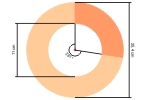
 

unikatissima Example Cone Template (Click picture to enlarge)
Great!
And what do we do now with the calculated degrees?
We cut them away ;-)
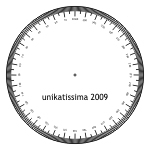
 

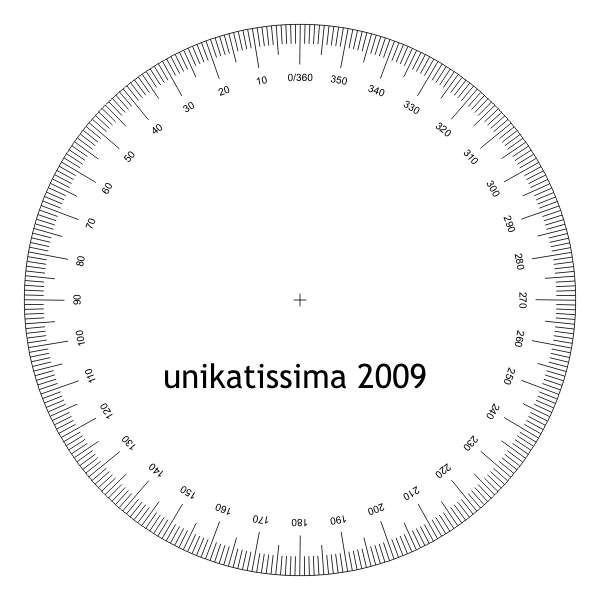
unikatissima 360 degrees disk (Click picture to enlarge)
If you don’t have a protractor you can print and cut the degrees disk.
Put the disk exactly centered into the ring and draw straight lines with a ruler from the center to the 0/360° label and (in our example) from the center to the 261° label.
The lines look then like the dotted lines on the previous picture and mark the area we have to cut away.
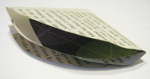
 

unikatissima Find Middle of Circle Note: I suggest to construct the cone template first with news paper or scrap paper.
To find the center you can then simply half fold the uncut circles twice (see the photo). Then it will be easy to place the protractor correctly.


Links:
At math central (English, French, Spanish):
List of already answered questions
Form to ask a question
Search form

Answer for the question with the subject: ‘Constructing a cone’
Answer for the question with the subject: ‘Pattern for a truncated cone’

At Wikipedia (German): The first 100 decimal places of Pi (Die ersten 100 Nachkommastellen von Pi)
At Wikipedia (English): The first 50 decimal places of Pi

Here at unikatissima:
Entries with the tag ‘fimo’
Entries with the tag ‘paper mache’

Candle Lit Photo Stands

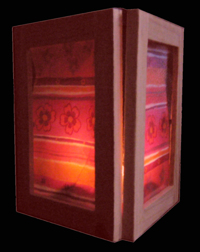
unikatissima Candle Lit Photo Stand

When there comes the time again where you can sit on your patio and dine with friends (ok, ok, it will still take some time, but a woman can dream ;-)), the candle lit photo stands can make a romantic atmosphere.
In the instruction they print their own photos on vellum and glue them on, I preferred my favourite gift wrap.
Besides you should also be able to use the topmost layer of the used paper napkins (possibly glued on vellum), then everything matches even better.


Links:
Photo Centerpiece

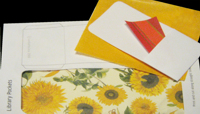
Library Pocket Book

unikatissima Library Pockets

I found a tutorial on how to make a wonderful library pocket book.
Though our library doesn’t have such library pockets and I don’t feel like buying them in internet.
That is why I designed some pockets myself. If you like you can download my library pocket template (link see below).
I’m planning to make a book where the pockets are made from patterned paper, the flower paper on the photo e.g.
For that purpose I will print the template, glue the paper so, that it is patterned on both sides and then cut the pockets from the template.
And then I will begin to embellish ;-))


Links:
Library Pocket Book

Here at unikatissima: unikatissima’s Library Pocket Template (PDF – ca. 80 KB)

Braided Bracelet with Beads

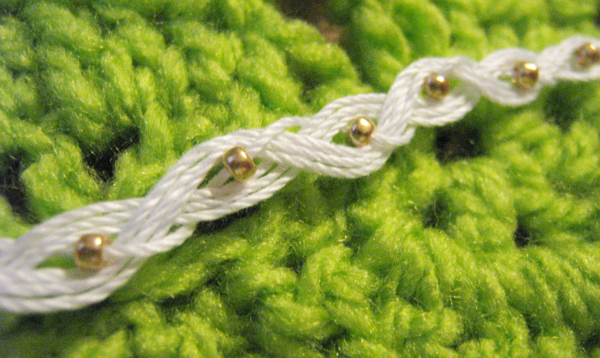
unikatissima Braided Bracelet with Beads.jpg

(Click on picture to enlarge)
Recently I saw a woman in the underground wearing a bracelet that I liked.
It looked quite easy and after trying it I noticed that it is ;-)


That’s what you do:
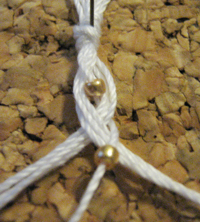
unikatissima Braided Bracelet with Beads Knot seven threads together and fix somewhere.
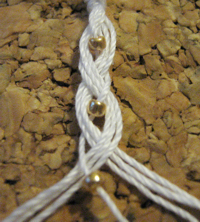
String beads on the middle thread and part the other six threads in two strands.
Note: I used some cotton crochet thread for the test because I didn’t have no beads to be strung on heavier yarn.


unikatissima Braided Bracelet with Beads Braid the three strands just like you’d do with your hair.
Make sure that the threads of the strands made of several threads lay neatly side by side.
As for the middle thread let lay a bead between the other strands at every braid.


Braid until you reached the desired length for a bracelet or a necklace and add a matching closure at both ends (links to closures see below).

The bracelet I’ve seen was made of hemp or the like, but I think that it would look great with fine leather strings, too.
As well I guess that one could use different sized beads and of course you can omit the beads.


Google search results for the making of closures:
Google search result for ‘bracelet closure’
Google image search result for ‘bracelet closure’

Google search result for ‘armband verschluss anleitung’
Google image search result for ‘armband verschluss anleitung’