Clothes From Crocheted Medaillons

Clothes From Crocheted Medaillons

Once I found the website of Jessica Tromp.
Hours later I regained consciousness ;-))

It is difficult to say, what I love best, but in the end I decided, that it must be the crochet patterns for/from square medaillons. But make sure to check all the other crochet patterns also (look for ‘crochet PATTERNS’ in the left navigation bar of her website).

Best of all, she designed a gazillion of clothes and each and every one for different women sizes!
In addition she offers basic woman measurement charts for clothing patterns.

I simply don’t find the right words for this site ;-))


Links:
Jessica Tromp:
Crochet patterns for/from square medaillons
Basic woman measurement charts for clothing patterns

Leftover Needlework

Leftover Needlework

I have a lot of yarn and thread rests, some of them quite short and I had no idea, what to do with them (except Freeform needlework as a matter of course ;-)).
And then one day I found an article about the ‘Magic ball’ an article about the ‘Magic ball’ and decided that this is it ;-)
In the bottom line it’s nothing else then taking your short threads and knotting them together (with a weaver’s knot e.g.) to get a long enough thread to knit or crochet or what ever you want to do.
On the photo you see three tests I did: On the item above I simply knotted different strings into a long thread and crocheted. It were quite short strings.
For the item below left I took two skeins of yarn, one green and one rose. I knitted with two threads and knotted them so, that I began working with 2 greens, then a green and a rose, then 2 rose, a green and a rose again and back to 2 greens. That way I got a kind of blend between the two colours.
The item below right is made in the same way, but with one light green and one dark green.

I’m sure that I will get back to this technique again.


Links:
Make your own magic using knotted yarn leftovers: the link isn’t available no more.

At unikatissima’s:
Freeform Needlework
Weaver’s Knot

Kumihimo Beads

Kumihimo Beads - Kumihimo Perlen

This Thursday’s 2nd challenge Beaded Beauties gave me the opportunity to do something I wanted to do for a long time: making Kumihimo beads.
Kumihimo is a Japanese technique to braid beautiful cords, but then: what do I do with the cord? It’s way too beautiful (and too labour-intensive! ;-)) to be used as a shoelace for instance.
I thought that it would make wonderful beads, but usually the braids are finished by wrapping some string around the braid and such beads would be much too long.


Kumihimo Beads - Kumihimo Perlen Therefore I figured out how to make my own Kumihimo beads.
The technique is far from perfect and I hope that you will try it and give suggestions to enhance the technique.

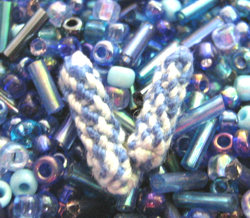
On the first two photos you see Kumihimo beads I made, the blue ones with cotton thread and the black and white ones with acrylic yarn.
All beads were made with 4 light and 4 dark coloured yarns, but I changed the initial positions on my cardboard Kumihimo disk.
You see at the surrounding seed beads how tiny my Kumihimo beads are.


Kumihimo Beads - Kumihimo Perlen What to do:
Make your Kumihimo cord. I worked about 20 rounds.
When finished, pull all threads into the bead.

And that’s where the problem lies:
If you make the Kumihimo cord ‘the normal way’ you won’t have enough place into the bead to pull all 16 threads in (8 threads at each side of the bead).
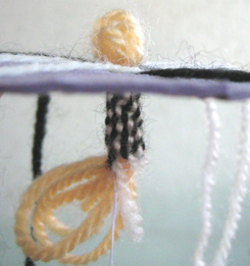
I tried different techniques to ‘reserve’ a place for the thick bunch of threads. The best one I found was making a bundle of 8 threads of the same gauge and using it as ‘filler’, that means, working around them (see third photo).


Kumihimo Beads - Kumihimo Perlen The Kumihimo beads are from fabric and can be stitched however you want. On this photo I surrounded my Kumihimo bead by seed beads and made a kind of Freeform Peyote Pendant.


Links:
This Thursday’s 2nd challenge Beaded Beauties

unikatissima’s Kumihimo How-to
unikatissima’s Freeform Peyote How-to


African Needle Weaving Necklace

African Needleweaving

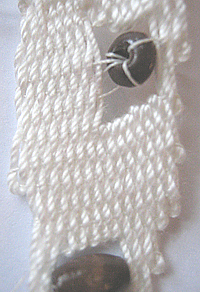
Once a found an instruction on how to work an african necklace using needle weaving (also called ‘pin weaving’). It’s a weaving technique that allows to easily create strange shaped fabrics and to incorporate beads into.
Stunning!
I played around with this technique and thought that it could as well be used for little bags, for bracelets and so forth.
Unfortunately it’s a technique that requires a lot patience – which I don’t have. ;-)
I’d love to hear what you think about!


Links:
African Needle Weaving Necklace

Crazy Daisies

Crazy Daisies - Wickelblumen

While searching for something else I found a lot of instructions and tips about Crazy Daisies and had to try them immediately ;-)

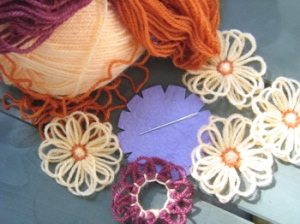
As you can see on the photo, my attempt on winding daisies on my own daisy loom worked out very well.
I cut the loom (the purple item on the photo) from thick cardboard. I think that the ice cream lid loom is better, because plastic won’t loose its shape so easily, but for just a couple flowers cardboard is fine.
At my first flowers I just made a very simple backstich center, but even so I find those little flowers stunning ;-)
The dark red flower is a daisy with an open center, but I made it in a different way: I didn’t wind the thread to the other side of my selfmade cardboard loom but to another notch (always the fourth notch in place of the sixth, I think. I didn’t write it down, because I don’t like it so much).
I’m planning to make something like the shrug with a lot of flowers and a simple crochet edging.
Eventually. ;-)


Links:
(all in English, but with explaining pictures and photos)
Instructions and tips about Crazy Daisies

For example:
Round ice cream lid daisy loom
Instructions on how to wind daisies
How to make a backstich center daisy
How to make a open center daisy
Simple crochet edging

Stole, Shrug, Handbag and Three Different Shapes on the Crazy Daisy Winder (from 1945)

Kumihimo

Kumihimo

Once I took a class for Kumihimo braiding – that is a japanese technique for braiding cords.
I really enjoyed the class and the work with the marudai, but I can’t afford to buy one. And although I found a tutorial on how to make your own marudai I prefer now to work with a cardboard disk. I braided for hours during train journeys. I can’t do this with a marudai ;-)

I didn’t find many instructions on how to make kumihimo cords in internet (see those I found below), so I will present my own.

On the photo you see my cardboard marudai and a braid I’m working on. I changed the pattern several times to get a more interesting appearance.

What you need:

  • 4 threads of yarn in 2 different colours (e.g. 2 red and 2 yellow) (test it e.g. with 100 cm/39 inches)
    Note: in the beginning both threads should be of the same gauge.
  • cardboard marudai disk (not too thin cardboard)
    Note: This is a cardboard disk with a hole in the middle and cuts around.
    For the beginning, 36 12-16 cuts are sufficient, later you may need more depending on the number of threads and the pattern.
    You can use the marudai picture as template to be cut from cardboard.
  • a little weight
    Note: I use mostly some coins in a little plastic bag.
  • quite a lot of patience ;-))

(click or scroll to go to the instructions below)


What you do:
(Click on pictures to enlarge)

Fold the threads in half and knot all together at the fold.
You have now 8 threads, connected to each other at one side.


Kumihimo Wedge the threads into the cuts as seen in pic. 1.
The knot is in the middle.


Cling your little weight to the knot of the threads. It provides a certain tension on the threads.


Kumihimo


Kumihimo Braid: Move the threads as seen in the pics 2 and 3 to the desired length.


After four moves you must have a ‘real’ cross again, otherwise you made a mistake.
But don’t worry, after a little practise you will see which thread should be moved next.

With 100 cm/39 inches you’re using quite short threads, but they tend to entangle anyhow. Therefore you must pull them free at every round. When the treads become longer, see to it to use some (self-made) bobbins.

The finished braid is a lot shorter than the threads, but I don’t know no factor.

Have fun
(and check the links to find more patterns)

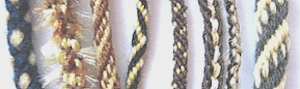
Here are some of my kumihimo cords, made with thin cotton to thick acrylic yarn:
Kumihimo

Kumihimo


Kumihimo I worked a lot of cords with different yarns in matching colours, included funky yarns and strands of beads and simply braided them together to get a big necklace:


Kumihimo And then I worked several braids with sewing yarn in matching colours, included metallic threads. Every braid has another braiding pattern. They are supposed to be a necklace, but up until know I haven’t finished it yet.
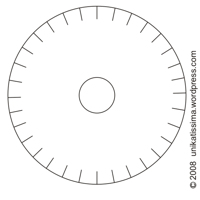


Kumihimo Marudai Cardboard marudai template (click picture to enlarge)


Links:
Wikipedia: English entry for ‘Marudai’

Wikipedia: English entry for ‘Kumihimo’German entry for ‘Kumihimo’


Self-made Marudai and bobbins:
Tutorial on how to make your own marudai

At Gabriela Marková’s Kumihimo blog:
Check the entries labelled with ‘Equipment’
Kumihimo braids:
Check Gabriela Marková’s Kumihimo blog

An instruction for a Kumihimo braid with 12 threads (with diagrams)

An instruction for a Kumihimo braid with 8 threads (German) (PDF-file) (with diagrams)
An instruction for a Kumihimo braid with 16 threads (German) (PDF-file) (with diagrams)

Diagrams for Kumihimo software, can be used as pattern (with diagrams)

See also how different your braid looks when changing the order of the threads or of moves (with diagrams)
An interesting pattern (with diagrams)

A pattern with 16 threads (with diagrams)

An instruction similar to mine (English) (PDF-file) (with diagrams)

An instruction for a Kumihimo braid with 12 threads (English) (with diagrams)

An instruction for a Kumihimo braid with 16 threads (English) (with diagrams)

An instruction for a Kumihimo braid with 8 threads (English) (with diagrams)

Linklists about Kumihimo:
Squidoo
Shelly Gillmann’s Kumihimo Links
Detangling Yarns

Detangling Yarns

The original title of this tutorial is ‘Knitting from both ends without going mad’ which is very to the point ;-)
I mostly work with the yarn end that sits in the skein to prevent the skein to roll all over, but then often the yarn entangles so much, that I nearly can’t work anymore.
This tutorial was really a relief ;-)


Links:
Knitting from both ends without going mad (with explaining photos)

Recycled Yarns

Recycled Yarns

I really like to crochet (ok, to knit also, but not soo much ;-)).
Anyhow, the yarns are quite expensive.
Therefore I was thrilled when I found the article ‘Recycling yarn / Unravelling thrift store sweaters’. In addition I found a tutorial on how to unravel a sweater.
Equipped with this new know-how I am anxious for the next thrift store visit ;-))
And then I will see to it to get some Kool-Aid or other food colouring to dye my newly achieved yarns myself as taught (amongst others) by knitty.com.
And if it works well, I will give self-made self-striping yarn a try (found via ‘Watermelon Socks’).
This will be better than my previously mentioned coloured yarns. And I think as much fun as the other recycled yarn made from plastic bags.

I’m curious about when I will find the time (and the place! ;-)) to do all this, but it is fixed on my to-do and to-try lists ;-)


Links:
Recycling yarn / Unravelling thrift store sweaters
Tutorial on how to unravel a sweater

Dying wool with food colouring
(For other tutorials google for ‘dye kool-aid’)

Self-made self-striping yarn
(via ‘Watermelon Socks’)

unikatissima’s entries:
Coloured yarns
Recycled yarn made from plastic bags

Crochet Spiral

Crochet Spiral

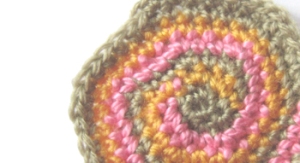
Sometimes you want to crochet not only a spiral, but a multicoloured spiral (beautiful in Freeform Needlework!).
I once found even two tutorials for crochet spirals, but the links don’t work anymore (I put them to the Links below in case you like to try them).
But because I didn’t found no more instructions I wrote a tutorial myself based on the previously found tutorials:

You will need 3 skeins of yarn in matching gauges.

Work in spirals, though NEVER JOIN!

st = stitch
sc = single crochet

1st row: work 6 sc on magic ring
2nd row: work 2 sc in each st = double each st = 12 st
work the 1st 4 st in colour A, the 2nd 4 st in colour B and the 3rd 4 st in colour C
3rd row: work * 1 sc, 2 sc in next st *, repeat from * to * = double each 2nd st = 18 st
work the 1st 6 st in colour A, the 2nd 6 st in colour B and the 3rd 6 st in colour C
4th row: work * 1 sc, 1 sc, 2 sc in next st *, repeat from * to * = double each 3rd st = 24 st
work the 1st 8 st in colour A, the 2nd 8 st in colour B and the 3rd 8 st in colour C
cont.


(Click picture to enlarge)
Crochet Spiral Hints:

  • At the colour change pull the loop of the ‘old’ colour into a large loop that you lay aside until you pick it up for the next round (see detail photo with loops).
  • The spiral gets hexagonal when worked this way. If you want to avoid this, move the place where you work two stitches in one stitch a little around (see photo above).


(Click picture to enlarge)
Crochet Spiral


Links:
Both links didn’t work when I tried them:
Crochet Spiral
Crochet Spiral


Magic ring
(Google results)
The Magic Adjustable Ring: A Better Way to Begin Crochet in the Round: very good illustrated instruction
Häkeln lernen: Der Fadenring (German)

Here at unikatissima:
Freeform Needlework

Fingerloop Braiding

Fingerloop Braiding

Sometimes you need some cord and one fun and fast way to make one is fingerloop braiding (for tutorials see Links below).
It is a medieval technique and I used it several times with good results.
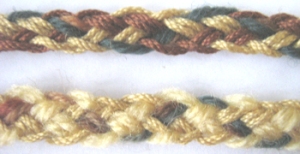
On the photo you see two of my self-made cords.
The most difficult part is for me to get the cord evenly, because you must adapt to the loops become shorter while working.
But it is only a question of practising ;-)


Links:
Fingerloop.org:
Basic Braiding Instructions

Phiala’s String Page:
Basic Braiding Instructions
Fingerloop braiding for two or more people

The Tudor Costume Page:
Making Finger Braids (many explaining photos)

Hochmittelalter Infoseite:
Fingerloop Braiding (German, very good illustrations)