Knotted Fabric Buttons and Beads

Knotted Fabric Buttons and Beads

I mentioned previously crocheted buttons, beaded beads, paper beads and fabric beads.
Another way to make your own buttons and/or beads is knotting fabric.

On the photo you see my first attempt on this technique: I admit that I still have to work on it ;-))
It is tiny (about 0,5 cm / 0.2 inches) and was made from a very light fabric that frayed heavily. I thought that this could look interesting, instead it looks unfinished.
Back to the drawing board ;-)


Links:
Knotted Fabric Buttons and Beads

At unikatissima’s:
Crocheted buttons
Beaded beads
Paper beads
Fabric beads

Rough Your Papers Up

Rough Your Papers Up

I like the so-called ‘Shabby Chic’ and tried some of the ‘Rough Your Papers Up’-Techniques. They make great backgrounds.
For the piece on the photo I took a gift wrap and sanded it very lightly (although it looks as if I worked hard on it ;-)). The scratches where spotless white, which was much to much contrast, but after I rubbed some ochre coloured chalk in, I like it much better.

Links:
scrapjazz techniques: Rough Your Papers Up

Wrap a Rock

Wrap a Rock

Embellishing rocks seems to be quite popular. Some people paint them, some people embroider them, some people felt them, some people wrap them in lace, some people wrap them in polymer clay, some people crochet them and some people bead them.
And if you want them to be fragrant, check back the previous mentioned Fragrant Rocks.
I never did anything with rocks, because I’m living on sandy ground ;-)
But all those rocks rock ;-)


Links:
Painted rocks (via CraftZine)
Embroidered rocks
Felted rocks
Lace wrapped rocks (via CraftZine)
Polymer clay covered rocks
Crocheted rocks
Beaded rocks

At unikatissima’s:
Fragrant Rocks

Embossing Yoghurt Lids

Embossing Yoghurt Lids

Once I found the suggestion to use the metallic lids of yoghurt cups for embossing (but I don’t know where). Some people use tomato paste tubes ;-)
The metal lid of the yoghurt cups is much softer and can easily be distorted, but they had a solution for this (unfortunately I don’t know anymore, who ‘they’ were): they filled the backside of the embossed metallic foil with PVA glue.

I tried it once and I like what happened.
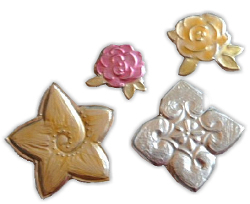
On the photo you see my results: I put the foil on the mouse pad, embossed it, cut it with scissors, filled the back with PVA glue and waited (!) for the glue to dry. I coloured both roses with nail polish.
The items are lightweight and less bulky than the tomato paste tube embossed. They can easily be used for cardmaking.


Links:
Tomato paste tubes revealed

Leftover Needlework

Leftover Needlework

I have a lot of yarn and thread rests, some of them quite short and I had no idea, what to do with them (except Freeform needlework as a matter of course ;-)).
And then one day I found an article about the ‘Magic ball’ an article about the ‘Magic ball’ and decided that this is it ;-)
In the bottom line it’s nothing else then taking your short threads and knotting them together (with a weaver’s knot e.g.) to get a long enough thread to knit or crochet or what ever you want to do.
On the photo you see three tests I did: On the item above I simply knotted different strings into a long thread and crocheted. It were quite short strings.
For the item below left I took two skeins of yarn, one green and one rose. I knitted with two threads and knotted them so, that I began working with 2 greens, then a green and a rose, then 2 rose, a green and a rose again and back to 2 greens. That way I got a kind of blend between the two colours.
The item below right is made in the same way, but with one light green and one dark green.

I’m sure that I will get back to this technique again.


Links:
Make your own magic using knotted yarn leftovers: the link isn’t available no more.

At unikatissima’s:
Freeform Needlework
Weaver’s Knot
Acryl Coloured Fabric

Acryl Coloured Fabric

As I found the tutorial on how to dye fabric with acryl colours I was thrilled, because I think that this way I can colour my fabric just the way I want.
I tried it immediately, but I have to work on it some more (and I will! ;-))
In a second entry Debra showed what she did with the paper towels she used to clean her workspace: isn’t it stunning?


Links:
Hand-dyed Fabric Trims
Dyed Paper Towels for Paper and Fabric Arts

Beeswax Collage

Beeswax Collage - Bienenwachs Collage

I find making collages fascinating.
One interesting technique to glue your items to the base is the so-called beeswax collage (for links to tutorials see Links below). It gives a warm colour to the collage and if polished a nice shine too.
On the photo you can see my first (and up until now last) attempt to do this. I collaged pieces of different newspapers (Chinese, Arabic, Corean) and self-made papers and than embroidered the spiral by hand.

Links:
At ARTchix Studio: Beeswax Collage: the link isn’t available no more.

At art-e-zine: Beeswax Collage

Google search results for ‘beeswax collage’
Google image search results for ‘beeswax collage’

Bicycle Bottle Holder

Bicycle Bottle Holder

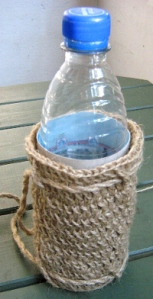
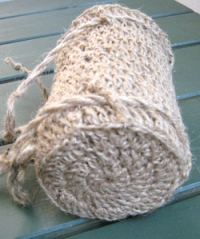
One day my friend asked me, if I have an idea how best to attach his water bottle to his bicycle. I promised him to make him a bottle holder and that’s it: It consists of a cardboard cylinder with bottom and a wrap crocheted from simple package string. I made two cords from the same package string to tie it somewhere to the bicycle.

And that’s how to do it:

  1. Cut a rectangle from cardboard.
    One side must be long enough to go around the bottle plus allowance, the other must be high enough, so that it holds the bottle safely.
  2. If you want the cardboard container to be (quite) waterproof, tape the inside with tape.
    Note: I used clear package tape.
  3. Wrap the cardboard around the bottle and wrap with long strips of tape.
    Hint: If it has to be waterproof, tape the whole cylinder.
    Hint: To make sure, that the cardboard container is not to tight around the bottle, I wrapped the bottle in several layers of old newspapers and wrapped the cardboard around the ‘thickened’ bottle.
  4. Cut a circle from cardboard, optionally tape the to-be inside with tape, too.
  5. Attach the circle with amply applied package tape to the bottom of your cardboard cylinder.
  6. Then you can create the outer container.
    Note: I crocheted it from package string by first crocheting a circle and then simply working straight up. ‘On the way’ I worked some thread eyes for the cords. The cords themselves were made from the same material.
    Hint: It should be easy enough to sew the outer container from a fabric matching your bicycle colours.
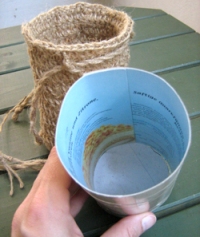
  7. The inner cardboard container and the outer crocheted container.
    Bicycle Bottle Holder Bicycle Bottle Holder


    Links:
    If a bicycle bottle holder isn’t enough for you, try the Bicycle Handlebar Bag.

    Making Any Sized Crochet Circles (English)
    Häkeln lernen: Runden und Spiralen (German)

    How to make Twisted Cord (English)
    Kordel drehen (German)

YoYo Pin

YoYo Pin

I like yoyo’s, but only recently I tried to make one. And I find it cute.
It is made from shiny polyester fabric and embellished with a little crocheted flower and some embroidered beads (I hate to have polyester on my skin, but I like it for pins and the like, because it is so shiny).


Links:
Yoyo Projects (with explaining pictures)
How to make a Yoyo (with explaining pictures)

The links don’t work anymore, you can find the information here now:
Yoyo Projects (with explaining pictures)
How to make a Yoyo (with explaining pictures)