Letter stencils

Letter stencils

Rosie showed her beautiful carved stamps and mentioned that she wants to carve letters too.
I prefer to use letter stencils, because I can use them in such a flexible way.
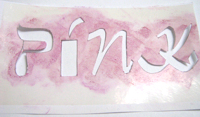
On the first photo you see a page from an artist book of mine yet to be finished. It has the theme ‘Colour’ and I stenciled the word ‘Pink’. On the other photo beneath you can see the stencil.

This is how I did it:
You’ll need:

  • Plain paper
  • Different fonts on your computer
  • Clear tape
  • Sharp knife, like an Xacto knife

What to do:

  1. Print the word you’re interested in in the requested size on paper.
    Note: You can use just one font, but I found different fonts for every letter more appealing.
    Note: Best are big fonts because they are easier to cut out.
  2. Put some clear tape on the print.
  3. Cut the letters carefully.
    Note: The tape makes the paper sturdier, so that the cutting is a little easier.
  4. Stencil your word wherever you want (paper, cardboard, fabric, glass, wood etc.).
    Note: I painted with a marker on the clear tape round the letters and smeared them with my fingers onto the paper.
Letter stencils The tape makes the paper not only sturdy, but also quite waterproof, so that you can use it several times with nearly every kind of colours. If necessary you can put tape on both sides of the paper prior to the cutting.

You can find a similar tutorial on instructables.com for making your own freezer paper and your own freezer paper stencil. I guess it is better for making bigger stencils, but I haven’t tried it.


Links:
Rosie’s carved stamps

Eraser Stamps Tutorials
Photo Stamps Tutorial

My Artist Book

Freezer paper and stencil tutorial

Photo Stamps

Photo Stamps

I already presented links on eraser carving, but perhaps you want to go a step further and make stamps from your own photos?
I found a tutorial on how to prepare your photos for carving stamps.
The preparation of the photos is similar to the tutorial on making your own digital stamps (and while we’re at it why not making stencils from your own photos? ;-))
On the picture you see a stamp template I made from a photo from a magazine.
Not yet cut, first I must find a big eraser ;-)


Links:
Prepping Photos for Carving
Carving 101

art-e-zine: a cornucopia for artists
Make your own digital stamps
Stencil Art

Here at unikatissima:
Eraser Stamps

Arm Knitting

Arm Knitting

I prefer crochet to knitting, mostly because I’m faster crocheting than knitting.
But then I found a tutorial on how to knit with your arms tutorial on how to knit with your arms – the speed of arm knitting arm knitting can’t be beaten ;-))
On the photo you see a scarf I made this way in no time. And you can see in the detail, that it is really knit – no cheating. Just chasing ;-))


Links:
Arm Knitting
The original site doesn’t exist any more and is now available through webarchive:
Arm Knitting

Beaded Bottle

Beaded Bottle Beaded Bottle

For some time I worked a lot with beads and the peyote stitch. Then I found a tutorial on how to bead a bottle and was thrilled – not only about the tutorial, but about my own results as well ;-))
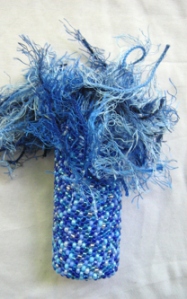
On the photos you can see two of my beaded bottles. I embellished the bottleneck of the blue one with funky fibers, the beading was made with a kind of bead soup* (I only used beads of the same size). The brown-golden one was made with just two sorts of beads, but I added some peyote ruffles at the bottleneck and a wire to use the little bottle as mini vase.


Beaded Bottle The third photo shows the bottom of the blue bottle.
* ‘Bead soup’ is on the whole an assortment of different beads, often with beads of different sizes and shapes. Many beaders use it for Freeform Peyote, but it can be used for many beading purposes. If you want to string the beads, use a bead spinner.


Links:
Tutorial on a Beaded Bottle
Peyote Ruffles

Google search result for ‘bead soup’
Peyote stitch:
About.com: Beadwork: A website with lots of tutorials about beadwork
Basic Beading Stitch Tutorials

Perlenhobby.de: A website with lots of (german) tutorials about beadwork: click on ‘Anleitungen’ in the sidebar left and there select one of the Peyote tutorials

Here at unikatissima:
Freeform Peyote
Making a Bead Spinner

Plaster Bowl

Plaster Bowl

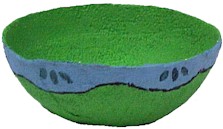
Because I like to make bowls this tutorial on how to make a plaster bowl is high on my what-I-really-want-to-do-list.
I worked with plaster already, but never with those plaster bandages and I hope that I will have the opportunity soon.
Once I have read (but I can’t remember where) that you can cut some old fabric (e.g. old bedsheets) in strips, pull them through the plaster and put them on to emulate the rigid wrap from the tutorial.
Has anybody tried this?


Links:
MakingFriends.com: A website with lots of crafts for children
Plaster Bowl

Flexagons

Flexagon Flexagon Flexagon Flexagon

Flexagons a quite interesting things: a kind of card with four sides, and you can flip from one side to the other, back and forth.
But to better understand what Flexagons are, how they work and how you can make one for yourself take a look at the Flexagon page.
On the photos you see the four pages of my first (and up until now last) flexagon. (Click on thumbnails to see the photos.)
It doesn’t work so well, because it is to bulky:
I made them from cardboard to make them lasting longer, glued then cotton on to the cardboard, because I thought that fabric would bend better if you flip them over and over and then glued on the pieces of my hand-embroidered and tape-transfered collages on the appropriate places.
Next time I will see to it that they get slender.
But anyhow: I love my flexagon ;-))


Links:
Flexagons

And if you want to embroider your collages:
English Embroidery Stitch DiagramsDeutsche Stickstichbeschreibungen
(see also Paper Crazy Quilt)

If you want to know more about image transfers
Easy Photo Transfers (different techniques)
Image Transfer
Packing Tape Image Transfers
(see also Artist Book)

Here at unikatissima:
Paper Crazy Quilt
Artist Book

Bead and Wire Wall Vase

Bead and Wire Window Vase

Inspired by two wonderful items, the Bead & Wire Heart at The Bead Bugle and the Bead Godesses from Ronda Kivett at the Autumn 2003 Issue of ARTitude Zine I did deliberately my vase from the photo.
I feel that I was a little too cautious, but I like it already.
Next time I want to get nearer to those shining examples I had.


Links:
Bead & Wire Heart at The Bead Bugle
Bead Godesses from Ronda Kivett at the Autumn 2003 Issue of ARTitude Zine


Self-made Crochet Hooks And Knitting Needles

Self-made crochet hook and knitting needles

Once I wanted to have a really big crochet hook and knitting needles and after I found tutorials on how to make them (see links below), I made myself some.
In fact they are so big that it is quite difficult to work with them ;-)
I use them very rarely – but if necessary, I can ;-)


Links:
Making Crochet Hooks:
Making Crochet Hooks from Chopsticks (with explaining pictures)
Make your own straight hook (with explaining pictures)

Making Knitting Needles:
Chopstick/dowel knitting needle tutorial

Coin Ring

Coin Ring

Browsing craftster I found one day the thread about coin rings.
Somewhere in the thread is also a link to a tutorial on how to make your own coin ring (with many explaining pictures).
I can’t image that I will ever do this, but I find it interesting enough to present it here.

Perhaps someone wants to make their weddings rings this way? ;-))


Links:
craftster: ‘coin rings! i’m an addict!!!’

Tutorial on how to make a coin ring

Organic Stripes

Organic Stripes

Note: the Random Stripe Generator doesn’t exist any more, but you can find two new links in my entry Random Stripes Generator.

While knitting or crocheting you sometimes want to stripe your workpiece. I find it difficult to design organic looking stripes.
Math can help here (although I’m not a very mathematical woman ;-)): At Fuzzy Galore you can find an article about the Fibonacci sequence which sounds perhaps difficult, but is quite easy.

And those who don’t want to figure out their stripes themselves can use the Random Stripe Generator. (I just tried the generator, but it didn’t work properly. Hopefully it will ‘recover’.)
(It did work properly, but I didn’t know how to use it ;-)
My problem was, that I entered a stripe width and thought, that this was the max. width.
But for the stripe width selection, it requires that you specify exactly which widths you want. So if you want widths of 1, 2, 3, 4, or 5 rows, you need to select all five of those check boxes, rather than just the box next to ‘5’.
Try it and you will get wonderfully striped patterns. :)))


Links:
Article about the Fibonacci sequence
Random Stripe Generator

Here at unikatissima:
Random Stripes Generator