Hand Knit-Weave

unikatissima Hand Knit-Weave

I discovered recently ‘knit weave’ (you can see pictures when following the links).
I like it! ;-)

Knit weave is mostly worked on knitting machines by laying a thread on the stitches. This thread is then trapped in the stitches and can be seen sometimes on the front side, sometimes on the back side of the item.
I found this interesting and thought that it should be possible to do this by hand.
I didn’t find very much (see links), therefore I’m reporting my own experience here.
Just a note: ‘knit weave’ can be translated in German by ‘Webstricken’, but when googling Webstricken you get quite different results: there are knitting needles where you can thread in an extra thread that will be worked in your item when knitting. But it looks different from ‘my’ knit weave.


That’s what you do:
In principle you carry an extra thread with you that will be laid on the front side and the back side of your work, alternately. That’s like weaving: the weft will be brought over and under.
I suggest not to let the extra thread lay on one side longer than four stitches. The float will get too long and your fingers can get caught.
Always check the extra thread tension to prevent it from hanging or contracting the knitted stitches.
You can see best what I’m talking about when checking the following examples:


unikatissima Hand Knit-Weave
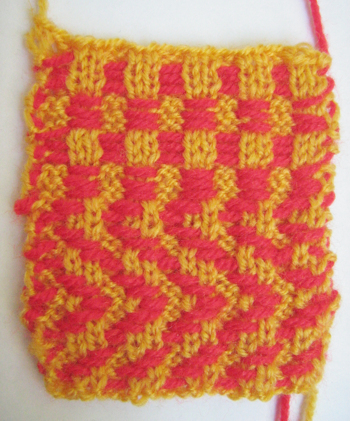
My first item.
I knitted the yellow item in a rib pattern two knit-two purl to prevent it from curling.
While knitting I carried a red thread that I always laid two stitches on the front side and two stitches on the back side of my work.
The back side looks similar.

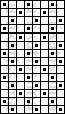
 

unikatissima Hand Knit-Weave Pattern unikatissima Hand Knit-Weave Pattern These are both patterns I used for my first item.
A filled square means: ‘lay the thread on the front side of your work’, an empty square means therefore ‘lay the thread on the back side of your work’.

(To download simply click on the image with the right mouse button and use something like ‘Save image as…’.)


unikatissima Hand Knit-Weave
My second item: This time I used kitchener stitch and I was pleasantly surprised to see that the item nearly don’t curl when knit woven.
Note: I’ve been told that this is not the kitchener stitch but the stockinette stitch.
In the end it doesn’t matter which stitch you use (to a certain point ;-)), but I see that I have still lots to learn about the English knitting vocabulary ;-)).
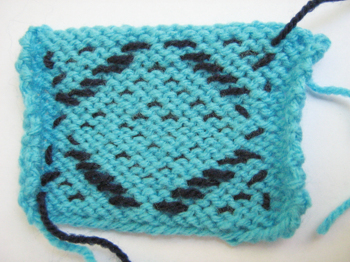
 

unikatissima Hand Knit-Weave
Here the back side: just as with multi-coloured knitting.
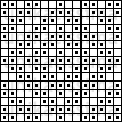
 

unikatissima Hand Knit-Weave Pattern That is the diamond pattern I used for my second item.

(The download works in the same way as above.)
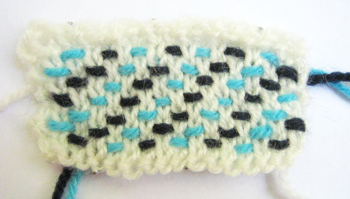


unikatissima Hand Knit-Weave
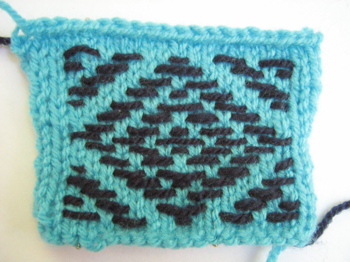
Then I wanted to know whether it works with two colours, too.
I think it does ;-))
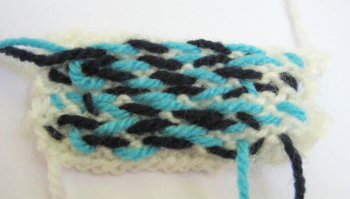
 

unikatissima Hand Knit-Weave
The item gets however quite thick because of the many yarns.
Besides I’m sure that you can make the whole thing much neater ;-)


unikatissima Hand Knit-Weave Pattern So, that is the two-colour pattern.
A square filled with a filled square (eehm…) means: ‘dark blue thread on the front side of the item’, a square filled with an empty square means: ‘light blue thread on the front side of the item’, an empty square means: ‘all extra threads on the back side of the item’.
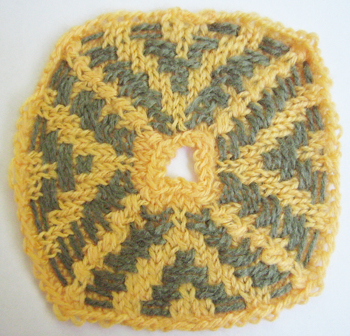


unikatissima Hand Knit-Weave
In the end I just played around with an extra: I knitted the (hmpf!) square from outside to inside in kitchener stitch by knitting three stitches together in the corners in every second row.
I carried the gray extra thread that I laid on the front side every second row shifted for one stitch.

Unfortunately I blocked the square made from acrylic yarn too hot, that ‘s why I can’t get it square anymore ;-(
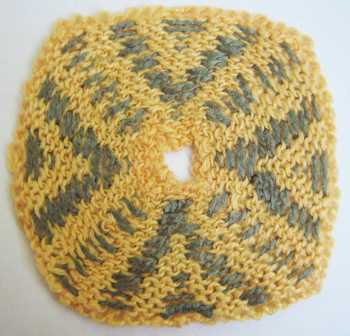
 

unikatissima Hand Knit-Weave
Here you can see the back side of the square.
The pattern is inverted and look also nice.


What I want to try next:

  • In the links you can find photos combining knit weave and lace knitting, I like this.
  • I want to carry a funky yarn once to see if one can still recognize the patterns.
  • I haven’t tried yet whether you can carry more than two extra threads.


Links:
Short Description ‘Knit-woven Effects’

Photos of machine knit woven pieces (with lace knitting)
Photos of machine knit woven pieces

Knit-Weave Patterns

A short movie about the technique that she uses there to weave in fur yarn => look there for ‘Hand knit-weave technique’

Meine kleine Buchkritik – My little book review: Kathleen Kinder, ‘The technique of Knitweave’) (German and English): actually I refer to the pictures because the reviewed book is about machine knit weave
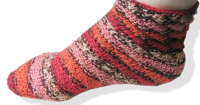
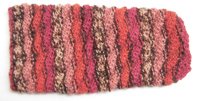
Sock without Heel

I once read somewhere (but I don’t remember, where) that you can knit a sock without a heel if knitting a given pattern.

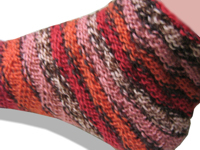
Therefore I tried it. I find the colours of the sock hideous, on the skein I still liked them, but here… ;-(
I won’t knit another sock.
Actually I should have it knitted higher up and it could have done with a cuff, but because I won’t wear it I restricted it to a Sneaker sock.


Anyhow, the thing about the given pattern is right: That’s how the sock looks like: flat ;-)

I began at the ‘cuff’ and at the toes I decremented by rule of thumb so not to get corners.

As for the pattern you alternately knit three, purl three stitches, every row the pattern is shifted one stitch.


The result is a kind of spiral rib-knit that makes the sock so elastic that it fits the foot all around very well.


Links:
The ‘pattern’

Little Improvised Knitting Helpers

Recently I knitted more often (mostly mazes and cellular automaton patterns) and got some little helpers together on the spur of the moment.

unikatissima Little Improvised Knitting Helpers
The first is a take-those-threads-away (I simply don’t know the name of this item!) for two-coloured knitting, that I made from a plain piece of wire: …


unikatissima Little Improvised Knitting Helpers … simply bend the wire twice around the finger, hook the threads into and begin knitting.


unikatissima Little Improvised Knitting Helpers The second are paper clips used as stitch markers…


unikatissima Little Improvised Knitting Helpers …that I hooked in every 10. stitch, everywhere where the decimal lines from the pattern are.
I selected a different coloured paper clip every five clips, that helps to orientate in the pattern faster.
For the partly chaotic cellular automaton patterns it can be a real help.


unikatissima Little Improvised Knitting Helpers And the last are my post-it notes I use to mark the row I’m working on.

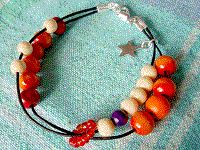
Some people use rulers but the post-its stick better to the paper and if necessary I can take it with me without having to mark the last row.
However I noticed that I have to change the notes quite often because the glue gets weak from the constant tackling and untackling.


Links:
At unikatissima:
Entry concerning the maze pattern generator
Maze Pattern Generator

Entry concerning the pattern generator (cellular automaton)
Pattern Generator (Cellular Automaton)

Knitting and Crochet Dictionary

unikatissima Knitting Crochet Dictionary

I have already presented translations of crochet terms, now I found even more complete translation lists at Garnstudio & DROPS Design (see links below at the links).
I find them a great help at translating patterns into/from other languages.


Links:
At Garnstudio & DROPS Design: select your language, e.g. ‘American’ or ‘English’, then select ‘Tips & Help’ in the top menu bar and there into the sub-menu select ‘DROPS Dictionary’ (at the end).
There you have lists in a lot of languages into/from which you get translations, at the moment English to/from Norwegian, Swedish, Danish, Finnish, Icelandic, German, Dutch, Spanish, Portuguese and French .

Row Counter Bracelet

Sutherland Studios Row Counter Bracelet

When knitting or crocheting you must often count the rows.
I have seen people who kept checklists in a very disciplined way, but personally I find this taking-the-pen-and-sketching-a-checkmark-on-the-list bothersome, the more so as one needs a table for this (at least I need it ;-)).
But not if you’re making a row counter bracelet (ok, you must leave your work beside, but you don’t need a table ;-)).
I didn’t make one yet, but I found the tutorial very good.

I’m sure that you can make the beads yourself, e.g. from polymer clay or felt (but felted beads may be too lightweight ?!)


Links:
Row Counter Bracelet
via: Row Counter Bracelet at ravelry

Google search result for ‘row counter bracelet’
Google image search result for ‘row counter bracelet’

Here at unikatissima:
Entries with the tag ‘polymerclay’
Entries with the tag ‘felting’

Knitted/Crocheted Bangles

unikatissima Knitted Bangle
Recently I wanted to make some knitted napkin rings as a gift and looked for a way to 1. keep their shape and 2. make them washable.
And I really found a solution which is also great for making bangles ;-)): use a core of recycled plastic bottle and a knitted or crocheted all over cover.


That’s what you do:
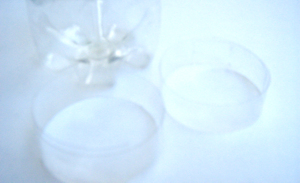
unikatissima Knitted Bangle Cut rings in the desired width from a plastic bottle.
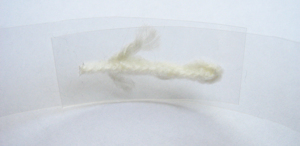
I cut here two rings because the circumference of the bottle was too small for a bangle for me.


unikatissima Knitted Bangle Where the rings are to be joined you need an overlap of about 2 cm.
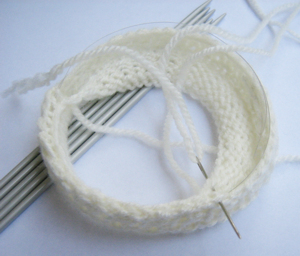
I pricked 3 holes with a pointy needle and threaded the yarn I used later for knitting through them to fix both sides. The big advantage is that you don’t see anything of this later.


unikatissima Knitted Bangle Then knit the ‘cover’. I worked with quite thick acrylic yarn and began with a stocking stitch part for the inside whereas outside I used a moss stitch pattern.
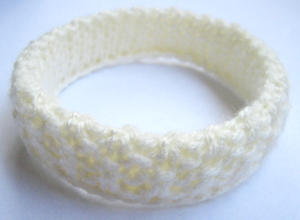
Depending on the used yarn the inside diameter can get a good deal narrower, in this case make the plastic rings a little bit larger.
When the cover is finished sew the sides together.


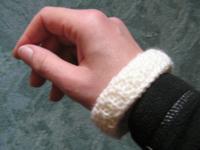
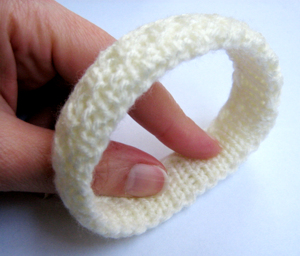
unikatissima Knitted Bangle That’s how the finished bangle looks.
Originally I wanted to have the seam at the inside of the bangle but I ‘produced’ always a thick bulged seam. Therefore I knitted the ‘folding line’ between both patterns with purls and sew at the rim (which is much easier, too ;-)).
The bulged seam looks similar to the purled row and now I like it.


unikatissima Knitted Bangle The plastic ring core has more advantages (besides the fact that it is cost-saving): the bangle keeps its shape but is flexible so that it doesn’t interfere with writing (usually I don’t wear bangles for just this reason).
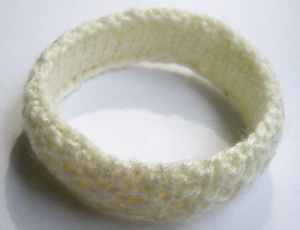
 

unikatissima Knitted Bangle What is more I can wash it: That’s how my bangle looks after I machine-washed it at 30°C together with dark(!) cloths.

No problem there ;-)
But this depends strongly from the used yarn.


I used thick acrylic yarn here and find that it looks like a winter bangle, but it can surely be crocheted as well with fine cotton thread or knitted in stocking stitch with variegated sock yarns or simply be wrapped with fun yarns, possibly even be wrapped with a sewn fabric cover…
If you try something like this I would appreciate if you’d link it in the comments!
Have much fun.
plastic bottle bracelet

What Can You Do With Filet Crochet/Cross Stitch Embroidery Charts?

unikatissima Two-coloured Chart (click to enlarge)

Recently something took me and I thought that you can use those two-coloured charts which are usually associated with filet crochet or cross stitch for a loooot of other techniques, too.
I had this idea already before, in my entries about intarsia knitting, the cross stitch heart, the beaded square stitch heart and the polymer clay letter cane.

On the photo you see some letters worked in different techniques (I’m working on letter charts at the moment ;-)):
'u' - Knit-Purl Knitting, each X is a purl stitch
'n' - Fair Isle Knitting, each X is a white stitch
'i' - Sequins Embroidery, each X is a sequin
'k' - Tapestry Crochet, each X is a white stitch
'a' - Filet Crochet, each X is a filled filet crochet square
't' - Cross Stitch Embroidery on paper, each X is a black cross stitch
'i' - Loom Beading, each X is a black bead
's' - Stamping with square stamps, each X is a black square stamp
's' - Illusion Knitting, each X is a black stitch over two rows
'i' - Crochet Yoyo’s, each X is a white crochet circle from dc’s
'm' - Inverted Filet Crochet, each X is a empty filet crochet square
'a' - Macramée/Friendship Bracelet, each X is a white knot

But then I came up with more techniques and if you still have more ideas I’d be glad if you wrote a comment about.
I added for every technique what would be a square of the chart.
Please remember: Not all ‘units’ are square so that the result can look quite different from the chart!

Knitting

Crochet

  • Tapestry Crochet – 1 stitch
  • Filet Crochet – 1 filet square (cross = filled square)
  • Inverted Filet Crochet – 1 filet square (cross = empty square)
  • Crochet Yoyo’s – 1 Crochet Yoyo, viz. a crochet circle from dc’s

Beading

Embroidery

Knotting

Weaving

Sewing

  • Patchwork/Quilting – e.g. 1 patchwork square
  • Yoyo’s – 1 Yoyo
  • Fabric Origami – 1 fabric origami square

Other

By the way I found an blog entry of an embroiderer who thought about the same subject and has more ideas.


Links:
Double Knitting
Picture for sequin embroidery (scroll down to about the middle)
Description of French Knot
Heather’s Friendship Bracelets – Alphabet Patterns
Geometric stitching
Google image search result for ‘yoyo blanket’
Google image search result for ‘ministeck’

Here at unikatissima:
Celtic Cross Stitch Generator
Heart Template (at Beaded Square Stitch Heart)

Patchwork Knitting
Bead Knitting
Illusion knit

Tapestry Crochet
Beautiful Filet Crochet Patterns

Loom Woven Bead Bracelet
Beaded Square Stitch Heart
Bead Knitting
Freeform Bead Embroidery
Bead embroidered Paisleys

Friendship Bracelet
Crazy Daisies
Crazy Daisies II

Tablet or Card Weaving

YoYo Pin
Fabric Origami

Mosaic Table Light (Glass Paint)
Polymer Clay Letter Cane
Mosaic from Plaster
Eraser Stamps

Resin Knitting Needles

craftster Resin Knitting Needles

You must absolutely check this!
Up until now I knew resin only for making jewelry, but this tutorial on how to make resin knitting needles is ingenious and the needles are fantastic!
However I recommend strongly to check the (admittedly many) comments, because they’re discussing there their (also bad) experiences.

If you are a little scared by resin just as I am you can however try to make some self-made wooden knitting needles.
But the others are more beautiful ;-)


Links:
At craftster: Resin Knitting Needles

Here at unikatissima:
Resin Pendants
Self-made Crochet Hooks And Knitting Needles

Needle Felting Your Knit

unikatissima Needle Felting Your Knit

I presented before some tutorials and inspirations on the subject of ‘felting’, but it were mostly instructions on how to produce something from felt.
The tutorial on how to felt on self-knitted items is a little different: we take a sweater or bag or the like that we have knitted (ok, bought works also ;-)) and applique a felt decoration.
I surely will give it a try once!


Links:
Decorate Your Knitting with Needle Felting

Here at unikatissima: entries with the tag ‘felting’

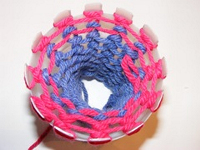
Knitting Loom from Plastic Bottle

knitchat Plastic Bottle Knitting Looms

I always wanted to play around with a knitting loom, but I won’t buy such an item!
Therefore I was delighted when finding the instruction on how to make a knitting loom from a plastic bottle.
For a begin she even added a tutorial for a much easier knitting loom from a toilet paper roll and some popsicle sticks (that’s no April Fool’s joke ;-))!

I will try the loom from the bottle in any case :)


Links:
Knitting Loom from Plastic Bottle (How To’s Day: Bored? Nothing to do, Make a knitting loom with stuff in your house!)

Basic Loom and Board Instructions
There are two PDF files: Knitting Board Basics (ca 790 KB) and Loom Knitting Basics (ca 3300 KB)

She even added a tutorial on how to make mitered squares with a knitting loom (see also here at unikatissima the Patchwork knitting and the Module Sock)

Here at unikatissima:
Patchwork knitting
Module Sock